
Why Beanie Baby Values Could Be Poised for a Comeback: The "Great Collection Dispersal" Theory
BeanieX Team · July 16, 2026
Beanie Babies may never return to the frenzy of the 1990s—but the next chapter of the hobby could be defined not by abundance, but by scarcity. The collectors who quietly preserve exceptional examples today may eventually discover that the greatest source of future value wasn't how many Beanie Babies Ty produced...
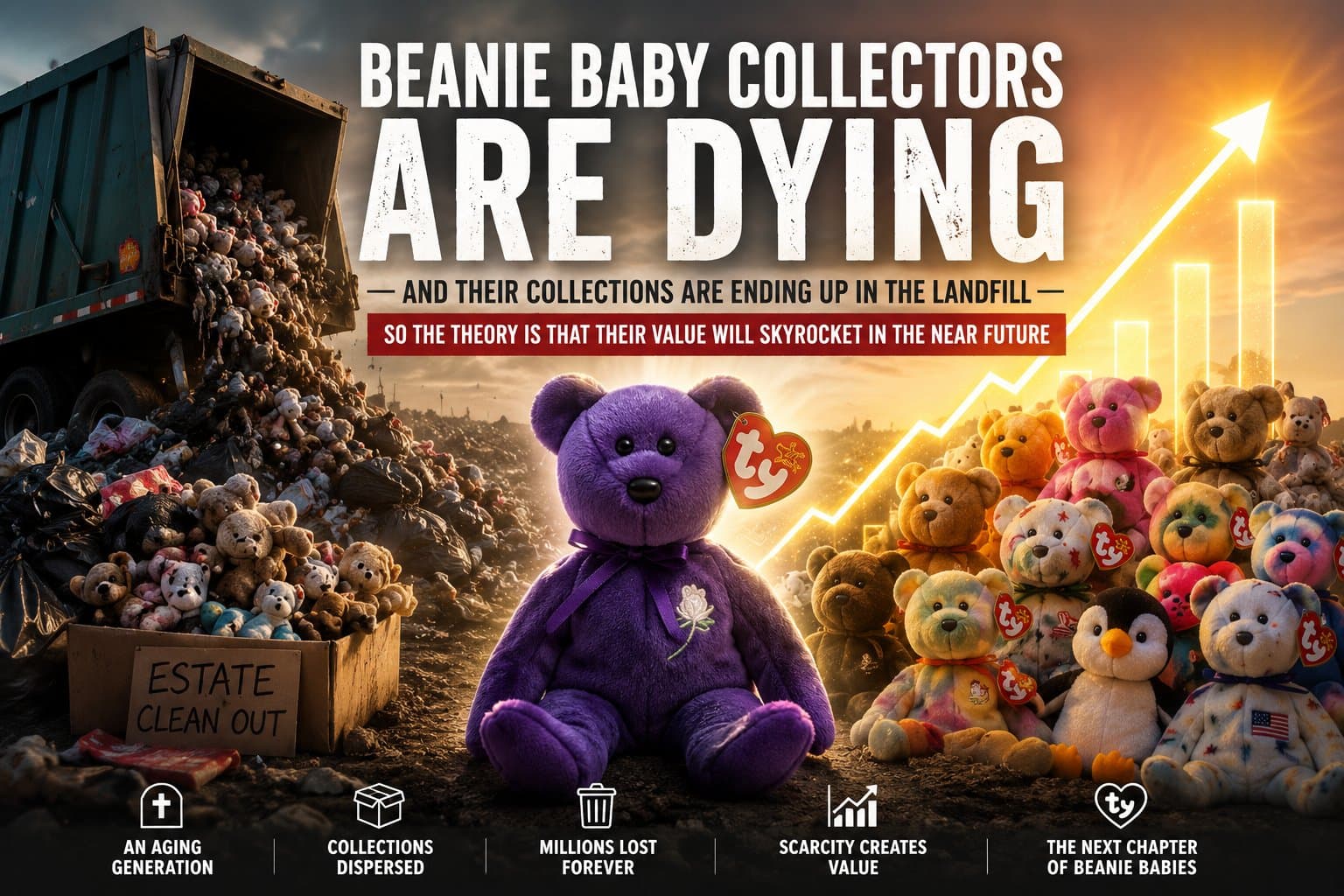
Why Beanie Baby Values Could Be Poised for a Comeback: The "Great Collection Dispersal" Theory
For years, Beanie Babies have been the punchline of the collectibles world. What was once one of the hottest crazes of the 1990s became synonymous with overproduction and unrealistic expectations. Millions of collectors tucked away closets full of plush toys, convinced they were sitting on a retirement fund.
But something interesting may be happening.
As longtime Beanie Baby collectors age, many of those carefully assembled collections are beginning to leave their original owners. Estate sales, thrift stores, donation centers, storage unit auctions, and unfortunately, even landfills are becoming unexpected destinations for thousands of Beanie Babies.
Could this be the event that finally makes truly collectible Beanie Babies scarce?
A Generation of Collectors Is Passing Their Collections On
The largest wave of Beanie Baby collectors emerged during the mid-to-late 1990s. Many of those collectors are now reaching retirement age or have begun downsizing their homes. Others have passed away, leaving family members to sort through collections they may know little about.
When heirs inherit hundreds—or sometimes thousands—of plush toys, they often face a difficult question:
"What do we do with all of these?"
Some collections are sold.
Many are donated.
Others are simply discarded.
Unlike coins, trading cards, or precious metals, Beanie Babies require storage space. To someone unfamiliar with the hobby, a room full of plush toys can appear to be little more than clutter.
The Hidden Cost of Storage
Large collections take up significant space.
For decades, many collectors stored Beanie Babies in climate-controlled rooms, plastic bins, or protective display cases. Maintaining those collections required time, money, and dedication.
The next generation may not share that same passion.
Without an interested buyer—or someone willing to invest the effort to identify valuable pieces—it becomes much easier to donate an entire collection than to research every individual tag variation or production error.
The Landfill Problem
Nobody knows exactly how many Beanie Babies have been discarded over the past twenty-five years.
There are no official statistics tracking donations or landfill disposal.
However, anyone who regularly visits thrift stores or estate sales has likely noticed an increase in vintage Beanie Babies appearing in recent years. At the same time, countless plush toys almost certainly never make it to resale shelves.
Once discarded, those Beanie Babies are permanently removed from the collectible population.
Unlike trading cards, which often survive in boxes for decades, plush toys are vulnerable to moisture, mold, pests, smoke damage, pets, and general wear. Every year, more examples disappear forever.
Scarcity Changes Markets
Nearly every collectible category follows a similar pattern.
An item may be mass-produced, but decades later only a fraction survive in excellent condition.
Comic books.
Vintage toys.
Baseball cards.
Video games.
Pokémon cards.
Many were once considered common.
Today, pristine examples command enormous premiums because so few remain.
Could Beanie Babies follow the same trajectory?
Possibly.
The key difference is that not every Beanie Baby will become valuable.
Condition Matters More Than Ever
Today's collectors increasingly focus on quality over quantity.
The Beanie Babies most likely to benefit from long-term scarcity include:
- Mint condition examples with both original tags.
- Rare production variations.
- Authenticated errors.
- Limited releases.
- Convention exclusives.
- Early-generation tag combinations.
- Professionally authenticated and graded examples.
As common, well-loved toys disappear over time, high-grade survivors may become increasingly desirable.
Authentication Is Changing the Hobby
One of the biggest changes in recent years has been the rise of professional authentication.
Services dedicated specifically to Beanie Babies allow collectors to verify authenticity, identify rare tag combinations, and preserve condition through encapsulation.
That mirrors the evolution of trading cards and comic books, where third-party grading created greater buyer confidence and helped distinguish exceptional examples from ordinary ones.
If grading continues to gain acceptance, collectors may begin paying larger premiums for authenticated, investment-quality pieces.
A New Generation of Nostalgia
Collectible markets often move in cycles.
Children grow up.
They enter their peak earning years.
They begin buying back pieces of their childhood.
We've already seen this happen with:
- Pokémon cards
- Nintendo games
- VHS tapes
- Tamagotchis
- Furby
- Polly Pocket
- Hot Wheels
- LEGO sets
Millions of millennials vividly remember Beanie Babies. Many collected them, traded them, or received them as gifts.
As nostalgia continues to influence collecting habits, demand could gradually increase.
Why Most Collections May Never Return to the Market
Ironically, one factor that could support prices is the opposite of what many people expect.
Instead of flooding the market forever, estate collections are often dispersed only once.
Some are donated.
Some are sold individually.
Some are lost forever.
After that initial transition, the surviving high-quality examples become concentrated in the hands of serious collectors again.
Over time, available supply may slowly shrink.
Our Theory
No one can predict the future of any collectible market, and there is no guarantee that Beanie Babies will experience a dramatic increase in value.
However, there is an intriguing possibility.
If thousands of ordinary collections continue disappearing through donations, damage, or disposal while nostalgia grows and authentication becomes more common, the highest-quality Beanie Babies could become significantly harder to obtain.
History has shown that rarity, provenance, condition, and nostalgia are powerful drivers of collectible markets.
Beanie Babies may never return to the frenzy of the 1990s—but the next chapter of the hobby could be defined not by abundance, but by scarcity.
The collectors who quietly preserve exceptional examples today may eventually discover that the greatest source of future value wasn't how many Beanie Babies Ty produced—it was how few survived in truly collectible condition.