
The Complete History of Beanie Babies: Boom, Bust & Comeback
BeanieX Team · September 17, 2026
Once upon a time, a small stuffed animal had a fairly straightforward job: sit on a bed, attend the occasional tea party, and survive being dragged through a grocery store. Then came Beanie Babies.
The Complete History of Beanie Babies: Boom, Bust & Comeback The Complete History of Beanie Babies: Boom, Bust & Comeback
How a pocket-sized menagerie charmed the world, inspired a collecting frenzy, and outlived its own bubble.
Once upon a time, a small stuffed animal had a fairly straightforward job: sit on a bed, attend the occasional tea party, and survive being dragged through a grocery store.
Then came Beanie Babies.
Suddenly, a plush lobster could inspire a treasure hunt. A bear's paper tag required its own protective equipment. Perfectly sensible adults began discussing retirement—not theirs, the frog's.
The history of Beanie Babies is a story of clever design, collector enthusiasm, early internet culture, and the spectacular things people do when cuteness meets the fear of missing out. It is also a story that continued long after the bubble burst.
Pull up a tiny chair. The animals have quite a tale.
1986–1993: Before the Beans, a Toymaker
Ty Warner founded Ty Inc. in 1986, after working in the plush-toy business. His early company sold stuffed cats before the little pellet-filled creatures that would make its name arrived. Warner's experience selling toys helped inform a product that felt different in the hand: softer, floppier, and easier to pose than a firmly stuffed animal. Ty Warner's early career
The brilliance was partly in what the toys lacked. They did not need motors, flashing lights, or a battery compartment that required a screwdriver and a family meeting.
They could simply flop.
That small quality gave them personality. An animal slumped on a shelf could look sleepy, curious, or mildly disappointed in your housekeeping.
1993–1994: Meet the Original Nine
Beanie Babies were introduced at the 1993 New York toy fair, with retail sales following in 1994. The founding menagerie consisted of Legs the Frog, Squealer the Pig, Spot the Dog, Flash the Dolphin, Splash the Whale, Chocolate the Moose, Patti the Platypus, Brownie the Bear, and Pinchers the Lobster. Brownie would later be replaced by Cubbie. Early Beanie Babies history
A platypus, a moose, and a lobster were an unlikely committee for world domination. Nevertheless, here they were.
At roughly five dollars apiece, the toys offered an accessible little treat. Warner emphasized independent gift and toy stores rather than the largest retail chains, giving those smaller shops a central role in the developing phenomenon. Ty's retail strategy
The initial reception was modest. The red heart tag did not instantly summon a crowd. The craze had to grow, one animal and one enthusiastic shopper at a time.
1995–1996: Tiny Poems, Big Personalities
One of the most consequential developments was also one of the sweetest: the animals gained birthdays and poems.
Ty employee Lina Trivedi proposed these additions in 1995 and wrote poems for the tags. She also helped bring Ty onto the web that year, connecting the product to a medium that was still unfamiliar to many households. Lina Trivedi's contributions
A birthday gave a collector something to recognize. A poem suggested a temperament. The animal became a little somebody.
This was a particularly effective invitation to children. Perhaps that tiger shared your birthday. Perhaps the bear seemed shy, like you. Perhaps you simply believed a certain pig deserved a good home.
Meanwhile, the website gave fans a destination for news and information. The toys could sit on a bedroom shelf while their humans went exploring online.
The contrast was delightful: old-fashioned stuffed animals, meeting the future through a noisy modem.
Why Retired Beanie Babies Became Collectible
Ty periodically stopped producing particular designs, describing them as retired. For collectors, retirement transformed a casual purchase into a decision with a deadline. The animal sitting in a shop today might be harder to find tomorrow. How Beanie Baby retirements worked
The word had excellent dramatic instincts.
“Discontinued” sounds like a dishwasher part.
“Retired” suggests that a small plush dolphin has packed a suitcase and moved somewhere sunny.
More seriously, it encouraged an important leap in thinking: if earlier retired toys had become desirable, perhaps the next retired toy would become valuable too. Collecting for pleasure and buying for future profit began sharing the same shopping bag.
1996–1998: The Hunt Becomes the Hobby
As enthusiasm spread, the experience of finding Beanie Babies became part of their appeal. The toys were objects to own, but also objects to pursue.
Zac Bissonnette's history of the boom describes an extraordinary trade built around independent shops, collectors, and rapidly rising expectations. What began as a small toy purchase could become a much larger commitment of money and attention. WBUR's account of the boom
For a child, the adventure might end with a new companion.
For a speculator, it ended with a calculation.
That difference mattered. A person buying a beloved animal could be satisfied indefinitely. Someone buying because the next person might pay more needed the excitement to continue.
Online trading expanded the possibilities. A collector was no longer limited to nearby stores or friends willing to swap. The internet connected scattered buyers and sellers, helping turn a local search into a much larger marketplace. Beanie Babies and internet collecting
The little animals had acquired a very large social circle.
1997: Would You Like a Tiny Moose With That?
In 1997, McDonald's introduced its hugely popular Teenie Beanie Babies promotion. Miniature versions of the toys brought the craze into Happy Meals and gave families another collection to chase. McDonald's archivist later recalled the promotion as a standout moment in the company's toy history. McDonald's Happy Meal history
Beanie enthusiasm now came with fries.
The appeal was obvious: take something already small and adorable, make it smaller, and tuck it into a familiar family ritual. Suddenly, collecting could influence the lunch plan.
The miniature toys also deserve their own place in the story. A Teenie Beanie and a full-size Beanie Baby belong to related product lines; they are not interchangeable editions of the same object.
1997: Princess and a More Tender Chapter
Following the death of Diana, Princess of Wales, Ty introduced Princess in 1997: a purple bear with a white rose on its chest, associated with fundraising for the Diana, Princess of Wales Memorial Fund. Initial shipments were limited, and demand was intense before wider availability followed. The history of Princess
Here, collecting intersected with public mourning. The bear was a toy, a tribute, and a keepsake connected to a person millions felt they knew.
Princess remains central to the Beanie Baby story partly because those meanings overlap. Its cultural importance, however, does not establish that every example is rare. Historical significance and scarcity are separate questions—a distinction easily lost when a familiar purple bear appears beneath a sensational price tag.
1998–1999: Why the Beanie Baby Bubble Burst
The boom encouraged some buyers to expect extraordinary future returns. Beanie Babies were increasingly discussed as investments, and the dividing line between collecting and speculation became harder to see. By the turn of the millennium, the speculative market had faltered. The rise and collapse of the Beanie bubble
The underlying problem was simple enough to fit inside a heart-shaped tag: a collectible needs someone who still wants to buy it.
Retirement could stop new production of a design. It could not guarantee endless demand for the examples already tucked into closets.
Nor did a printed valuation make money appear. An anticipated price, an asking price, and an actual sale were three very different animals.
The episode is often remembered as a punch line, but people who lost money were dealing with real disappointment. The lesson deserves more kindness than a joke about somebody's attic.
The bears themselves, of course, had made no promises.
1999–2000: The End! Except, Actually, the Beginning
In 1999, Ty announced that all Beanie Babies would retire at the year's end. The company subsequently held a public vote on whether the line should continue. About 90 percent of participating voters favored keeping it going, and production continued into 2000. The 1999 retirement vote
A bear named The End marked the farewell; The Beginning followed the reversal. The line's continuation
Few product lines have staged an exit with quite so much theatrical flair.
The curtain fell. The audience objected. A bear came back out.
But continuing the toys could not automatically restore the conditions that had created the speculative frenzy. Beanie Babies survived; the expectation that practically any purchase might become a windfall did not fare as well.
The 2000s: Life After the Spotlight
Ty continued developing products after the boom. Beanie Babies 2.0 arrived in 2008 with codes for an accompanying online experience. Licensed characters also joined the wider Beanie Babies range. Later Beanie Babies developments
The brand was adapting to a changing toy world.
For older collections, the meaning could change too. A toy originally purchased with resale in mind might become a reminder of a grandparent, a childhood bedroom, or a Saturday spent visiting shops together.
An object can lose its imagined investment value without losing every reason someone wanted it.
Sometimes, once the price chatter quiets down, you can hear the story attached to it.
The 2020s: The Toys Become the Story
The craze eventually received a Hollywood retelling. Released in 2023, The Beanie Bubble dramatized the business and relationships behind the phenomenon. Its characters drew on real people, including Patricia Roche, Faith McGowan, and Lina Trivedi, whose contributions complicate the familiar story of a lone entrepreneurial genius. It is a dramatization, rather than a documentary. TIME on the film and its real-life inspirations
Meanwhile, Ty still sells Beanie Babies alongside other plush ranges. The company's present-day storefront is a useful reminder that the brand's history did not stop when the investment bubble did. The official Ty store
What Makes Beanie Babies Collectible Today?
Looking back, Beanie Babies helped show how product news, online communities, scarcity, and resale could reinforce one another. Their story also illustrates how easily an enjoyable hobby can become entangled with expectations that the market cannot fulfill.
For collectors researching older toys, specifics matter more than folklore. Even “tag error” is not a magic phrase: specialist guides warn that some widely advertised printing errors were produced in huge numbers. Beanie Babies Price Guide
But collecting does not have to be an endless audition for the most valuable object.
It can be the pleasure of completing a little menagerie. The satisfaction of recognizing a childhood favorite. The absurd happiness of discovering that someone, somewhere, once decided the world needed a floppy plush lobster.
Beanie Babies began as toys, became a phenomenon, and survived becoming a cautionary tale.
Through it all, the animals kept their expressions.
The frog still looks patient. The pig still seems pleased. The bear, freed from the responsibility of financing anyone's retirement, is perfectly content to sit beside you.
That was a pretty good job to begin with.
Frequently Asked Questions About Beanie Babies
When did Beanie Babies first come out?
Ty introduced Beanie Babies in 1993, with retail sales following in 1994. The original nine included familiar characters such as Patti the Platypus, Legs the Frog, and Chocolate the Moose. Early history
Why did Beanie Babies become so popular?
Their approachable price, distinctive personalities, retirement announcements, and growing online collector community helped turn small plush toys into a phenomenon. Speculation added urgency: some people bought animals they loved, while others hoped to resell them for more. The collecting boom
Are all retired Beanie Babies valuable?
Retirement means production of a particular design stopped; it does not establish how many survive or how many buyers want one. Research the specific version and comparable completed sales before assuming that a retired toy is valuable. Retirement and collectibility
Do Beanie Baby tag errors make them rare?
Not automatically. Some frequently promoted errors appeared on large numbers of tags. A documented unusual variation needs to be distinguished from a common printing mistake. Tag-error guidance
Are Beanie Babies making a comeback?
They remain an active toy line, and their history continues to attract attention. A broader collecting comeback is a plausible possibility, rather than an established return to 1990s demand or prices. Nostalgia gives the category a compelling story; sustained buyer interest would determine the scale of any revival. Current Ty products, the 2023 film
A Beanie Babies Comeback? The Next Chapter Could Be Hiding in a Toy Box
There is a hopeful case that Beanie Babies are poised for a comeback—not because every bear is secretly a fortune, but because they offer so much of what makes collecting enjoyable: recognizable characters, a memorable history, and the possibility of finding something special that someone else overlooked.
The children who once carried them everywhere can return with adult curiosity. New collectors can discover the animals without having lived through the frenzy. A humble toy box can become a doorway into design variations, old tags, and the strange, wonderful history of a global obsession.
There are still hidden gems out there. Some may be overlooked collectible examples that deserve closer identification; others are the exact childhood companion someone has spent years hoping to find again. There is no reliable count of undiscovered rarities, and a dusty storage bin is no guarantee of treasure. That uncertainty is part of the hunt.
The opportunity is to look carefully. An ordinary-looking animal deserves identification before dismissal, just as an extraordinary asking price deserves scrutiny before belief. Learn the differences, preserve the tags, and let evidence guide the exciting discoveries.
A comeback need not recreate the old bubble to matter. A growing community of people who enjoy finding, studying, trading, and keeping these toys would be a worthwhile next chapter all by itself.
Somewhere, a little lobster may still be waiting for someone to notice him.
He has been remarkably patient.
Publishing Metadata — Not Part of the Article Body
SEO title: History of Beanie Babies: Boom, Bust & Possible Comeback
Meta description: Explore the history of Beanie Babies, from the original nine and the 1990s craze to the bubble burst, hidden gems, and the case for a nostalgic comeback.
Suggested URL slug: history-of-beanie-babies
Primary search phrase: history of Beanie Babies
Related phrases used naturally: original nine Beanie Babies; retired Beanie Babies; Beanie Baby bubble; Beanie Babies comeback; collectible Beanie Babies; Beanie Baby tag errors.
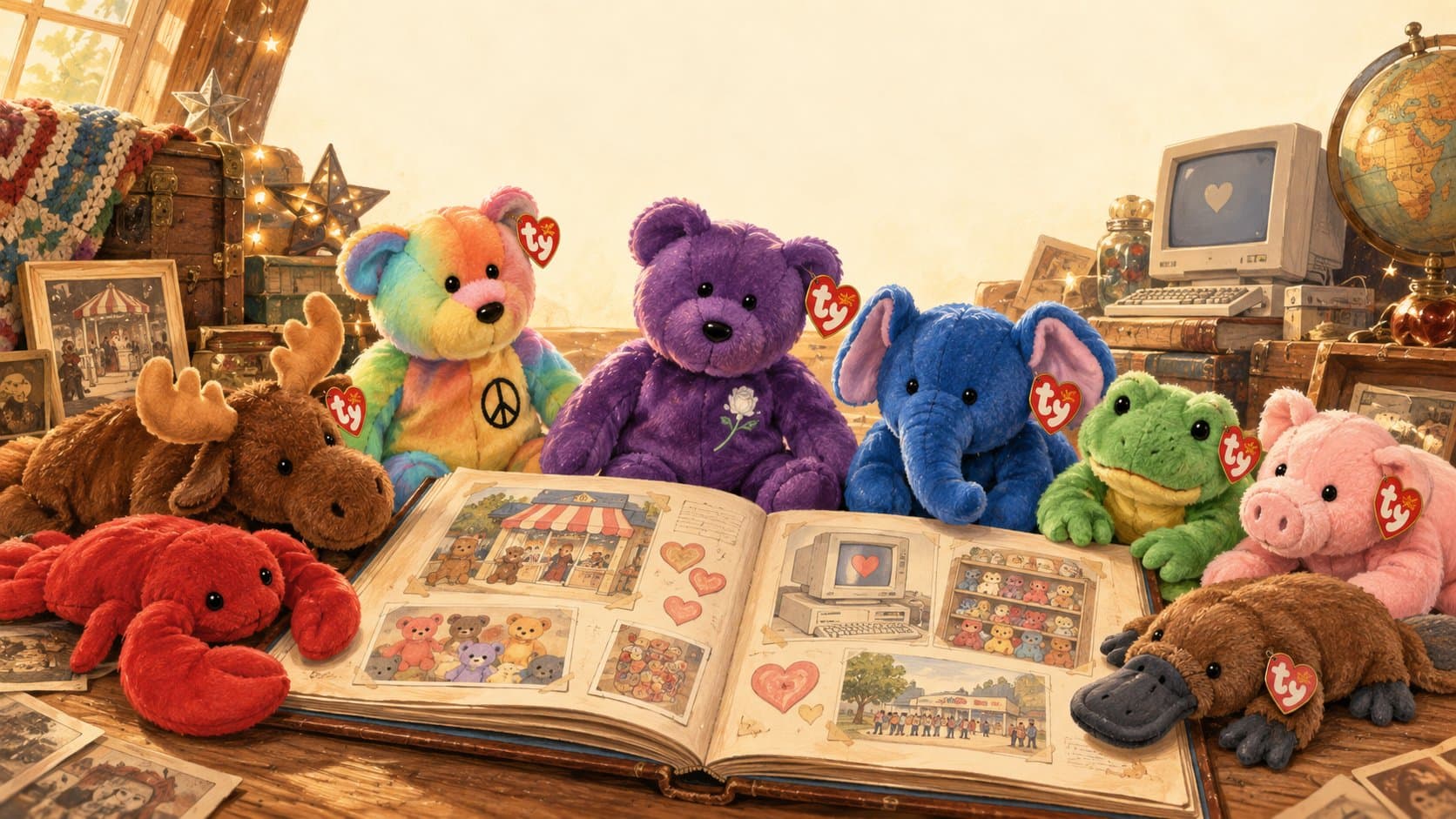
Hero image alt text: Whimsical illustration of colorful Beanie Babies gathered around an open scrapbook celebrating their collecting history.
Suggested hero filename: history-of-beanie-babies-hero.webp
Implementation notes: Use the article title as the page's single H1 and retain the chronological H2/H3 hierarchy. Set an accurate author byline and publication date. Use Article or BlogPosting structured data with real author, date, canonical URL, and hero-image details. Link from relevant collecting pages and add contextual internal links to existing identification or selling guides where available. Compress the hero image, provide responsive sizes, and set its dimensions. Keep this metadata section out of the published article body. Search rankings and rich results are not guaranteed.