
Peanut the Elephant: History, Rare Versions & Value
BeanieX Team · September 23, 2026
Discover Peanut the Elephant’s Beanie Baby history, royal blue vs. light blue differences, tag identification, authentication tips, and collectible value.
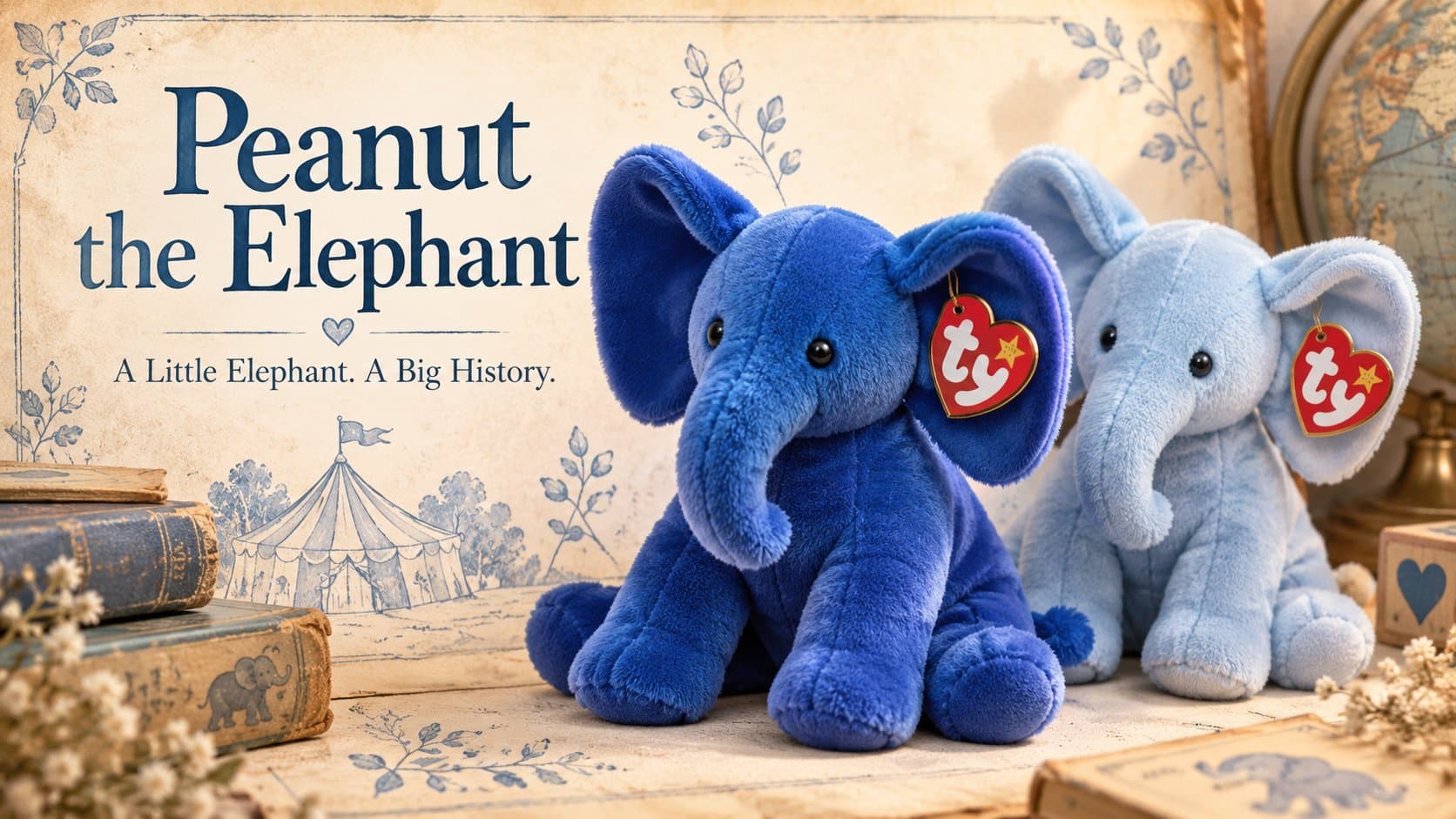
Peanut the Elephant: Beanie Baby History, Rare Versions, and Collector’s Guide
Some elephants make an entrance with a trumpet. Peanut managed it with floppy ears, a little red heart tag, and a shade of blue collectors would never forget.
Peanut the Elephant debuted as a royal blue Ty Beanie Baby in June 1995. A light blue version followed that October, creating the color distinction at the heart of Peanut’s collecting history. The original royal blue release had a short run and became a coveted collectible; the light blue elephant carried the character into many more collections. [1][2]
That sounds like a simple wardrobe change. In the world of Beanie Babies, it became an excellent reason to inspect every elephant in the toy bin.
Whether you are researching a childhood favorite, identifying a thrift-store find, or considering a royal blue Peanut for your collection, the details matter. Color is the beginning of the story. Product line, tags, condition, and authenticity help tell the rest.
Peanut the Elephant History: Which Blue Came First?
Royal blue came first. Ty Collector and Beanie Babies Price Guide list the original Peanut’s introduction as June 3, 1995, with retirement on October 2, 1995. Both identify the original Beanie Baby as style 4062. [1][3]
The light blue version arrived in October 1995 and remained in the line until May 1, 1998. Collector references differ slightly on its exact introduction date: Ty Collector lists October 1, while Beanie Babies Price Guide lists October 2. The sequence is clear even with that one-day discrepancy. [2][4]
Milestone
Date
Significance
Royal blue Peanut introduced
June 3, 1995
The original Peanut Beanie Baby arrives
Royal blue Peanut retired
October 2, 1995
The first color has a brief release window
Light blue Peanut introduced
October 1995
The lighter version replaces the original color
Light blue Peanut retired
May 1, 1998
The classic light blue release ends
Peanut joins Beanie Buddies
1998
Larger versions expand the character’s reach
Peanut II anniversary release
2023
A purple interpretation revisits the familiar design
Timeline sources: Ty Collector, Beanie Babies Price Guide, and Beaniepedia. [1–6]
Why Did Peanut Change Color?
Ty Collector attributes the change to Ty Warner’s belief that a lighter blue would appeal more to children. That account supports describing Peanut as a design change; it does not require presenting a dramatic factory mistake as established fact. [1]
The result was a character with two very different collecting stories. One color had a short window. The other became the Peanut many people remember owning.
For collectors, this is part of the fun: a small design decision can leave a much larger historical footprint.
How Peanut Fits Into the Beanie Baby Craze
Beanie Babies began as small, deliberately understuffed animals that were easy to pose and collect. Retirements and restricted availability later helped turn the hunt for particular characters into a much bigger phenomenon. [7]
Peanut offers a particularly easy-to-understand example of that appeal. Two elephants could share a name and basic design while representing different releases. Once you knew there was an earlier color, finding “a Peanut” was no longer quite the same as finding the Peanut you wanted.
That distinction invites the kind of questions collectors love: Which version is this? Which tags belong with it? How does it compare with the example already on my shelf?
The character’s historical importance is more interesting than a sensational asking price. Peanut makes the transition from cuddly toy to closely studied collectible visible in a single color change.
Royal Blue vs. Light Blue Peanut: What Is the Difference?
For the original Beanie Babies, start with this comparison:
Feature
Royal blue Peanut
Light blue Peanut
Color
Deep, saturated blue
Pale, powder blue
Original release
June 1995
October 1995
Style number
4062
4062
Documented hang tag generations
Third generation
Third, fourth, and fifth generations
Collecting focus
Short original release and authentication
Tag combinations, condition, and completeness
The tag information above comes from specialist collector references. It is a starting point for identification, not a substitute for examining an individual toy. [3][4]
Royal Blue Peanut: The Original Collector Favorite
The original royal blue Beanie Baby is the version to investigate carefully when someone mentions a “rare Peanut.” Beanie Babies Price Guide highlights both its desirability and the substantial counterfeit problem surrounding it. [3]
A dark blue elephant alone does not establish that identification. Before celebrating a lucky find, determine whether you are holding the original Beanie Baby, a larger Beanie Buddy, a miniature, or another release.
Light Blue Peanut: A Classic Worth Looking Closely At
Light blue Peanut deserves more attention than a quick “wrong color” dismissal. Its documented tag generations span several versions, providing details for collectors who enjoy comparing releases. [4]
If you find one, photograph its tags before assigning a value. Do not assume that two light blue examples are identical because they look similar across a room.
And if your favorite Peanut is a well-loved childhood elephant with no tags at all, its place in your collection does not need an auction result to justify it.
Beanie Baby, Beanie Buddy, or Teenie Beanie?
Peanut’s name appears across different Ty products. Knowing the product family prevents some of the most expensive identification mistakes.
Peanut Beanie Buddies
Ty introduced Beanie Buddies in 1998 as larger interpretations of familiar characters, including royal blue and light blue Peanut. These belong to a different product line from the small original Beanie Baby. [5]
A particularly confusing detail is the royal blue Buddy’s tag text: it refers to the rarity of the royal blue Beanie Baby. That description should not be interpreted as proof that the larger Buddy has the same rarity or value. Beaniepedia specifically calls out this misunderstanding. [8]
Read the collection name on the tag before comparing prices. “Peanut” tells you the character; the product line tells you which collectible you are researching.
McDonald’s Teenie Beanie Peanut
Peanut also appeared as a miniature McDonald’s Teenie Beanie. The light blue version is documented in the 1998 promotion. [9]
These little elephants can make charming additions to a character collection. Keep their comparisons within the same miniature release and packaging condition. A sealed promotional toy and a vintage full-size Beanie Baby are different items, even when both have familiar blue ears.
Peanut II: The Anniversary Return
In 2023, Peanut II appeared in the 30th anniversary range. Beaniepedia describes this version as fuchsia purple with blue inner ears and a blue tail tip; Ty also maintains an official Peanut II product page. [6][10]
It is a documented later interpretation of the character. Its different color does not make it an undiscovered 1995 variation.
For a display, a modern Peanut II alongside an older blue Peanut offers a lovely visual way to show how the character has been revisited over time.
What About Pastel, Tie-Dye, and Glow-in-the-Dark Peanut?
Colorful claims need specific evidence. The references used for this guide do not substantiate a classic 1990s Peanut range of pink, green, and purple pastels, a tie-dye Peanut release, or a glow-in-the-dark Peanut. They also do not establish the claimed 1998 Attic Treasures Peanut from the earlier draft.
Those claims have therefore been excluded from the release history. This is different from claiming that no unusual prototype, custom toy, or later similarly named product could exist.
If you encounter an unfamiliar elephant, ask for the exact name, product family, style number, and clear photographs of both tags. A documented release should be identifiable beyond a seller’s description of “super rare.”
How to Identify a Peanut the Elephant Beanie Baby
Think of identification as building a small evidence file. Each detail should agree with the others.
- Establish the Product Line
Read the tag for the collection name. Record the toy’s measurements and photograph its overall shape. This helps separate a Beanie Baby from a Buddy or miniature before you research further.
- Photograph the Color Accurately
Use indirect daylight, a neutral background, and no color filters. Include several angles. Strong warm lighting or a heavily edited photograph can make color comparison unnecessarily difficult.
If you are buying online and the blue is unclear, request another photograph. Guessing from a single dim image is a poor foundation for an expensive purchase.
- Record Both Tags
The hang tag, also called the swing tag, is the paper tag attached to the toy. The tush tag is the fabric label sewn into it. Photograph the front and back of the fabric label and every panel of the paper tag.
For the original royal blue Peanut, Beanie Babies Price Guide documents a third-generation hang tag and a first-generation black-and-white tush tag bearing a 1995 copyright date. [3]
Matching those broad features is only an initial screening step. It does not prove that the materials, printing, stitching, or tag attachment are authentic.
- Separate Birthday From Manufacturing Evidence
A character’s birthday is part of its identity. It should not be treated as proof of the exact day an individual toy was manufactured. Likewise, a copyright year alone cannot answer every question about a release.
Write down what the tags actually show, then compare the complete combination with an appropriate reference.
Authenticating Royal Blue Peanut
Authentication deserves its own step because counterfeit royal blue Peanuts are documented. Ty Collector discusses differences involving fabric, proportions, ears, trunk, and tag printing; Beanie Babies Price Guide recommends authenticated examples because of the counterfeit risk. [1][3]
For a potentially valuable example, seek a specialist with experience in vintage Ty Beanie Babies. Ask what the examination covers and whether the opinion addresses both the toy and its tags.
Useful questions include:
Is the certificate or written opinion tied to this specific elephant?
Do identifying photographs match the item offered for sale?
Are any tags missing, damaged, replaced, or questioned?
Can the claimed authenticator and report be verified?
What happens if the item does not match its description?
A statement such as “guaranteed authentic” is most useful when it comes with evidence and clear terms. Keep copies of the listing, photographs, receipt, and any authentication documentation.
How Much Is Peanut the Elephant Worth?
There is no useful single price for every toy called Peanut. Identify the version first, then evaluate comparable sales.
This guide does not assign a current dollar range because it does not include a verified sample of recent, like-for-like completed sales. That avoids presenting an old result or an ambitious asking price as today’s market value.
When researching your own example, separate these factors:
Factor
What to check
Exact release
Original royal blue, light blue, Buddy, Teenie, or later edition
Authenticity
Quality of supporting evidence and specialist review
Tags
Correct combination, attachment, legibility, creases, and damage
Fabric and construction
Stains, fading, repairs, seam damage, and wear
Sale context
Date, selling venue, fees, shipping, and documented condition
Use Comparable Sales Carefully
Search for the exact product line and version. Compare several completed sales when available, checking photographs rather than relying only on listing titles.
An unusually high asking price shows what one seller hopes to receive. A single sold listing also needs scrutiny: was the item correctly identified, authenticated, and comparable in condition?
If the evidence is thin, describe the value as uncertain. A careful estimate is more useful than an impressive number attached to the wrong elephant.
Do Tag Errors Make Peanut Valuable?
Treat “tag error” as a claim to investigate. Ask the seller to identify the precise difference and provide evidence that collectors distinguish and pay for that particular variation.
A typo, date difference, or unusual label should not automatically become a large premium. Verify what it is before deciding what it is worth.
Buying, Selling, and Caring for Peanut
If you are buying, choose listings with clear original photographs, readable tags, accurate measurements, and a specific condition description. For a rare-version claim, request supporting evidence before agreeing on a price.
If you are selling, make the identification easy to assess. State the product family and color, disclose missing tags and damage, and distinguish your own identification from a documented authentication opinion. Avoid borrowing rarity claims from a different Peanut release.
For storage and display, handle paper tags gently, keep the toy out of direct sunlight, and choose a clean, dry space. Avoid attaching adhesive labels to the toy or its original tags. Before cleaning an important vintage example, seek advice about its materials and condition; aggressive treatment can create a new problem.
One particularly helpful habit is to keep a collection record. Save photographs, measurements, purchase information, tag details, and authentication paperwork together. Your future self—and a future buyer—will appreciate the effort.
Frequently Asked Questions About Peanut the Elephant
Which Peanut the Elephant Is Rare?
The original royal blue Beanie Baby is the short-run version highlighted by collector references. A royal blue Buddy or miniature must be researched separately. [3][8]
Was Royal Blue Peanut Released in 1996?
No. Specialist references list its introduction as June 3, 1995, and its retirement as October 2, 1995. [1][3]
Is Every Light Blue Peanut the Same?
No. The original light blue Beanie Baby has multiple documented tag generations, and Peanut also appears in other product lines. Identify the complete item before comparing it with another. [4][5][9]
Can Peanut Still Be Collectible Without Its Tags?
Yes, but missing tags remove useful identification evidence. Describe the condition accurately and compare it with similarly incomplete examples instead of assuming the same value as a fully tagged toy.
Is Purple Peanut a Real Ty Release?
Peanut II is a documented purple anniversary release from 2023. That does not support treating a purple elephant as an original 1995 Peanut. [6][10]
Can a Photo Prove Royal Blue Peanut Is Authentic?
Photographs can support preliminary screening, but a photo alone should not be treated as conclusive authentication. A specialist may need additional views or an in-person examination.
Peanut’s Legacy: A Little Elephant With a Big Story
Peanut has everything a memorable collectible needs: a recognizable design, a story worth learning, and enough detail to reward a closer look.
The royal blue original gives history-minded collectors a challenging pursuit. Light blue Peanut offers a familiar connection to childhood. Later versions provide another way to enjoy the character without needing to own its earliest release.
Could nostalgia introduce Peanut to another generation of collectors? Certainly. Anniversary releases give people a reason to rediscover old favorites, although renewed affection should never be confused with a promise of rising prices.
There is still pleasure in the search: opening a childhood storage box, spotting a familiar trunk at a secondhand shop, or finally understanding the tags on an elephant you have owned for years. Sometimes the hidden gem is an overlooked variation. Sometimes it is the toy you are simply delighted to see again.
Bring that curiosity to BeanieXchange, and keep learning the details behind the characters you love. Peanut’s best lesson is wonderfully simple: look closely. A small blue elephant can have quite a story to tell.
Sources and Further Reading
Ty Collector: Royal Blue Peanut — original release dates, color-change account, and counterfeit indicators.
Ty Collector: Light Blue Peanut — dates and tag generations.
Beanie Babies Price Guide: Royal Blue Peanut — tags, release history, and authentication concerns.
Beanie Babies Price Guide: Light Blue Peanut — dates and tag combinations.
Ty Collector: Beanie Buddies Family — larger Peanut versions and the 1998 launch.
Beaniepedia: Peanut II — 2023 anniversary release.
Beanie Babies: Design and History — general background on construction and collecting.
Beaniepedia: Royal Blue Peanut Collecting Notes — distinguishing the Beanie Baby from the Buddy.
Beaniepedia: Light Blue Teenie Beanie Peanut — the 1998 miniature release.
Ty: Peanut II — official product page.
<!-- Publishing note: Use the supplied title, description, and slug in the corresponding CMS fields. Keep a single H1. The generated hero is an artistic illustration and should not be used to demonstrate authentic proportions or tag details. Add relevant internal links only to existing BeanieXchange pages whose URLs and content have been checked. -->