
How to Find Valuable Beanie Babies in a Massive Collection
BeanieX Team · September 8, 2026
If you’ve inherited, rediscovered, or purchased a massive collection of Beanie Babies, the hardest part usually isn’t selling them—it’s figuring out **which Beanie Babies are actually worth your time**.
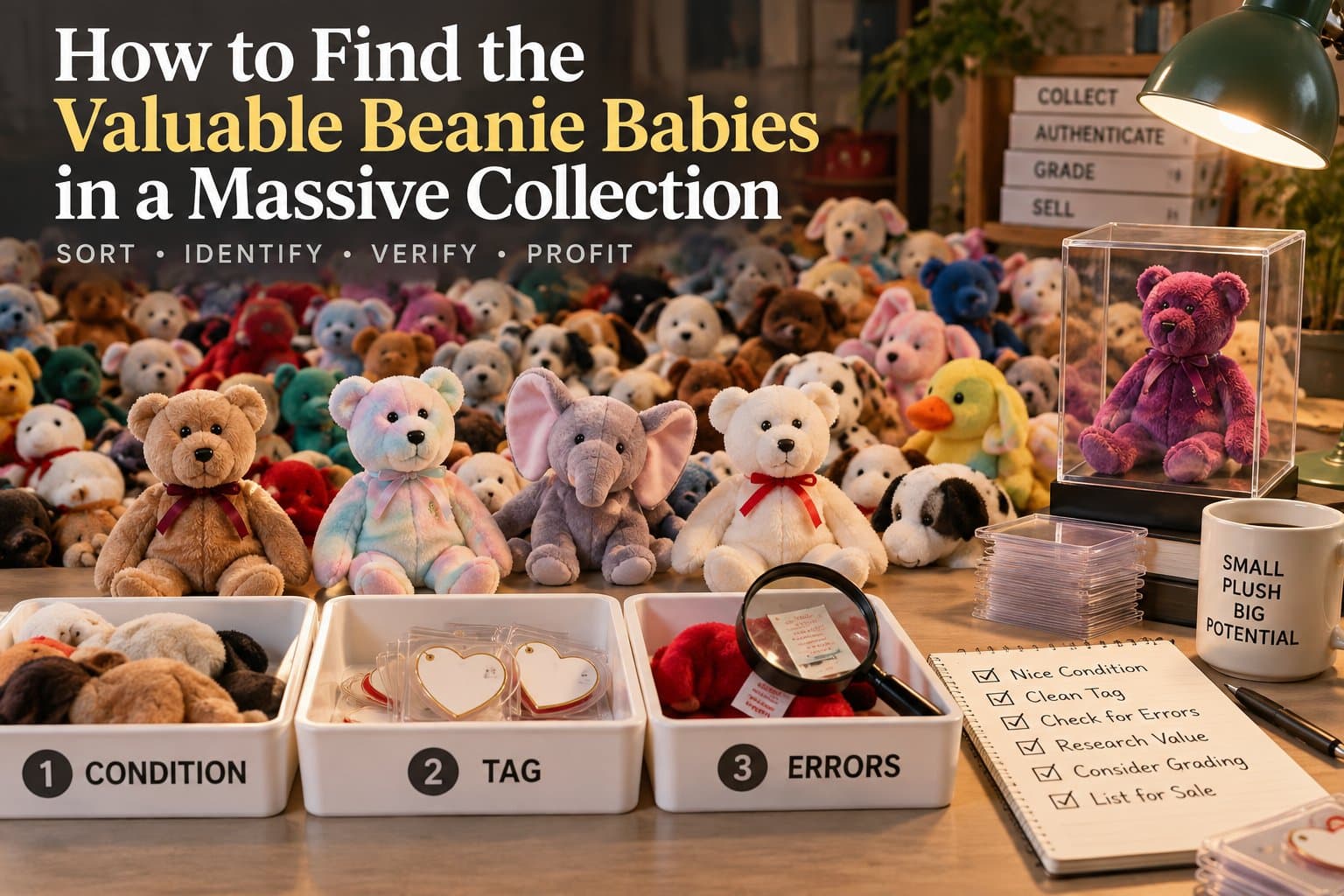
How to Find the Valuable Beanie Babies in a Massive Collection
Going through hundreds of Beanie Babies individually can quickly become overwhelming. And sending an entire collection for professional authentication or grading usually doesn’t make financial sense.
Instead, you need a system for narrowing hundreds of Beanie Babies down to the handful that deserve closer research, professional grading, or individual sale.
The good news is that you don’t need to be a Beanie Baby expert to make the first cut.
Start with three things:
1. Condition 2. Tags 3. Errors and unusual characteristics
In that order.
Here’s how to turn a mountain of Beanie Babies into a manageable group of potentially valuable collectibles.
---
Step 1: Condition Comes First
Before researching dates, tag generations, errors, or rare variations, look at the Beanie Baby itself.
Condition is one of the biggest factors affecting Beanie Baby value.
Collectors generally pay the strongest prices for examples that look like they were purchased yesterday and immediately stored away.
When sorting a large collection, create a separate pile for Beanie Babies that appear exceptionally clean.
Look for:
- Clean, bright fabric
- No stains or discoloration
- No odors
- No holes or loose seams
- No excessive handling or flattened fur
- Clean eyes and noses
- Original shape and stuffing
- No writing on the tags
- An intact hang tag
- An intact tush tag
Don't spend 15 minutes researching every common Beanie Baby you pull out of a storage tote.
Your first pass should be fast.
If a Beanie is dirty, heavily played with, missing its hang tag, or obviously damaged, put it in the bulk-sale pile unless you already know it is an especially scarce variety.
If it looks exceptionally clean and complete, move it to the next round.
The Mint-Condition Test
Ask yourself:
“Would a serious collector describe this as mint or near mint?”
If the answer is clearly no, you can usually move on.
If the answer might be yes, start examining the tags.
---
Step 2: Check the Hang Tag and Tush Tag
Once you've separated the best-condition Beanie Babies, tags become your next major filter.
The familiar heart-shaped Ty hang tag changed numerous times during the Beanie Baby era. Collectors commonly refer to these versions as tag generations.
Earlier-generation tags can be particularly important because they can help identify Beanie Babies produced before the craze reached its peak.
Start With the Hang Tag
Look closely at the red heart-shaped tag attached to the Beanie.
Don't simply check whether it exists.
Open it.
Look at:
- The design of the tag
- The wording inside
- Copyright information
- The Beanie's name
- Birth date
- Poem
- Country information
- Font and spacing
- Any unusual printing
An older-looking or unfamiliar tag deserves additional research.
Then Check the Tush Tag
The fabric tag sewn into the Beanie Baby can provide another important clue.
Compare the information on the tush tag with the hang tag.
Pay attention to:
- Copyright dates
- Manufacturing location
- Ty branding
- Tag style
- Registration or trademark symbols
- Spacing and typography
- Whether the information matches the hang tag
Certain combinations of hang-tag and tush-tag generations can help narrow down when a Beanie Baby was produced.
Protect Good Tags Immediately
If you discover a Beanie Baby with an unusually crisp hang tag, protect it.
Don't repeatedly bend the tag while researching it.
Collectors care about:
- Creases
- Bent corners
- Tears
- Fading
- Writing
- Price stickers
- Surface wear
A beautiful Beanie with a badly damaged tag may be considerably less desirable than an otherwise identical example with a pristine tag.
---
Step 3: Look for Errors, Variations and Oddities
Now you have a much smaller group.
This is when searching for Beanie Baby errors and variations becomes worthwhile.
Errors are probably the most misunderstood part of Beanie Baby collecting.
Online listings routinely describe ordinary printing differences as "$10,000 RARE ERRORS." An asking price does not establish an item's value.
Some variations can matter to collectors. Others are extremely common.
The key is determining whether your Beanie has a documented and genuinely collectible variation, rather than simply spotting a typo and assuming you've hit the jackpot.
Things Worth Investigating
Examine your shortlisted Beanie Babies for:
- Name discrepancies
- Date discrepancies
- Unusual tag combinations
- Misspellings
- Missing or unusual punctuation
- Manufacturing differences
- Different fabrics or colors
- Different stuffing characteristics
- Unusual production locations
- Retired or changed designs
- Known transitional versions
- Documented limited-production variants
If something looks different, research the exact variation before assigning value to it.
Don't Fall for the "Rare Error" Trap
One of the biggest mistakes new sellers make is searching eBay for their Beanie Baby and sorting through active listings.
Someone can list a common Beanie Baby for $25,000.
That doesn't mean anyone will buy it.
When researching how much a Beanie Baby is worth, prioritize actual completed sales and comparable examples. Make sure you're comparing the same Beanie, tag generation, variation, and approximate condition whenever possible.
---
Step 4: Research the Shortlist, Not the Entire Collection
This is where the sorting system starts saving serious time.
Imagine starting with 500 Beanie Babies.
After your condition check, perhaps 150 survive.
After examining tags, maybe 40 look interesting.
After checking dates, generations, known variations, and unusual characteristics, perhaps 10–20 deserve serious research.
That's much easier than researching 500 Beanie Babies individually.
Your final shortlist should contain Beanies that have one or more compelling characteristics:
Excellent condition + desirable tags + documented scarcity or variation is the combination you're really looking for.
---
Step 5: Decide Which Beanie Babies Are Worth Grading
Professional authentication and grading can make sense for certain Beanie Babies, but not every Beanie Baby should be graded.
The cost and effort need to make sense relative to the potential value.
Consider professional grading or authentication when you've identified a Beanie Baby that appears to have:
- Exceptional condition
- Early-generation tags
- A valuable documented variation
- Known scarcity
- Significant collector demand
- Authentication concerns
- Enough potential value to justify the expense
Two services collectors can investigate are BeanieXchange and True Blue Beans.
BeanieXchange provides Beanie Baby-focused authentication and grading resources designed to help collectors evaluate important examples.
True Blue Beans is another established name collectors may encounter when researching professional Beanie Baby authentication and grading.
Before submitting, review each service's current grading standards, authentication process, pricing, turnaround times, and submission requirements.
Professional authentication can be particularly useful when authenticity itself has a major impact on value.
---
Step 6: Sell the Best Beanie Babies Individually
Once you've identified your strongest pieces, don't bury them inside a giant collection listing.
Potentially valuable Beanie Babies generally deserve individual listings with detailed photographs.
Photograph:
- Front
- Back
- Both sides
- Face
- Hang tag exterior
- Every page inside the hang tag
- Front and back of the tush tag
- Any errors or variations
- Any flaws
The goal is to give knowledgeable collectors enough information to evaluate the Beanie without guessing.
For ordinary Beanie Babies that didn't survive your sorting process, bulk lots can be far more efficient.
Group them by:
- Animal
- Holiday
- Bear
- Era
- Theme
- Collection size
That lets you spend your time on the Beanies where additional effort could actually produce a return.
---
The Fast Beanie Baby Sorting Method
When facing hundreds or even thousands of Beanie Babies, remember this order:
1. CONDITION
Pull out the cleanest, most complete examples first.
2. TAGS
Check hang-tag and tush-tag generations, dates, condition, and combinations.
3. ERRORS & VARIATIONS
Research unusual characteristics and determine whether they're actually recognized or desirable.
4. COMPARABLE SALES
Look for evidence that collectors are paying a premium for the exact version you own.
5. AUTHENTICATE OR GRADE
Reserve professional grading for your strongest candidates.
6. SELL
List the valuable pieces individually and consider selling common Beanies in groups.
---
You Don't Need to Research Every Beanie Baby
This is the most important takeaway.
If you have 10 boxes of Beanie Babies sitting in your garage, you don't need to become an expert on every Beanie in those boxes.
You need to become good at eliminating the ordinary ones.
Start with condition.
Then inspect the tags.
Then investigate errors, variations, production differences, and scarcity.
By progressively narrowing the collection, you can turn hundreds of unknown Beanie Babies into a small group worthy of serious research—and potentially discover something that shouldn't be tossed into a $20 bulk lot.
BeanieXchange can help collectors take the next step by researching, authenticating, grading, buying, and selling Beanie Babies in one collector-focused ecosystem.
Because when you're staring at 500 Beanie Babies, the question isn't “What is every Beanie Baby worth?”
It's:
“Which ones should I be paying attention to?”
And now you know where to start.