
Holiday Beanie Baby Gift Guide 2026: Buy, Sell & Profit
BeanieX Team · November 16, 2026
Discover the best holiday Beanie Babies to gift, collect, and resell in 2026. Learn real values, buying tips, and how to turn vintage Beanies into profit.
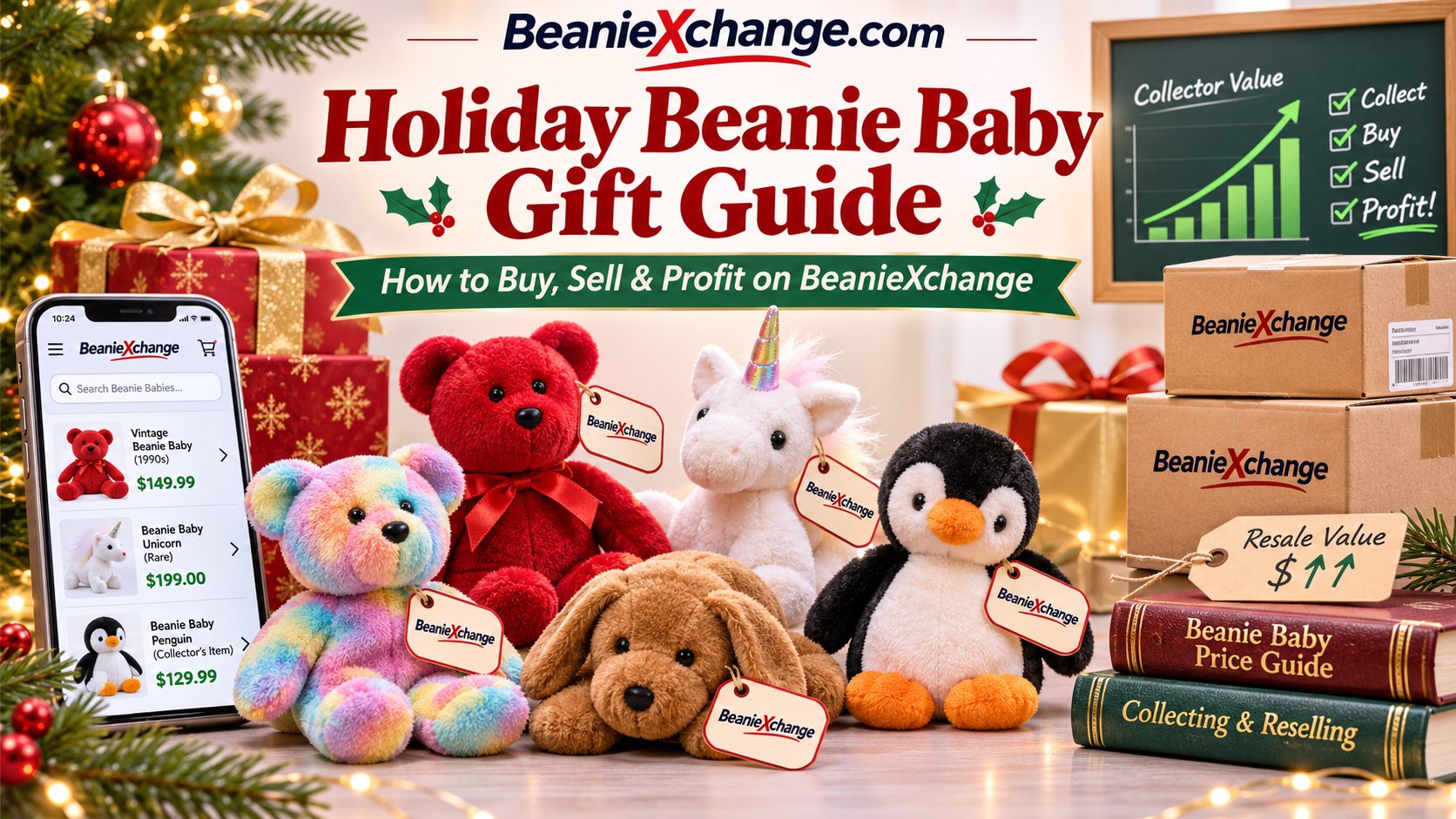
Holiday Beanie Baby Gift Guide 2026: What to Buy, What to Gift, and How to Turn Nostalgia Into Profit
By the BeanieXchange Team | November 2026
Remember when finding a Beanie Baby under the Christmas tree felt like discovering buried treasure?
For millions of kids growing up in the 1990s, those little plush animals were more than toys. They were collectibles, trading currency on the playground, and sometimes the most coveted presents of the holiday season.
Nearly three decades later, Beanie Babies are making their way back onto holiday shopping lists. Only this time, there's an interesting twist: the same toys that once sent collectors racing between Hallmark stores and gift shops can now be found at thrift stores, estate sales, garage sales, and online marketplaces for a fraction of their original collectible-era prices.
And for savvy buyers, that creates an opportunity.
Whether you're searching for a nostalgic Christmas gift, building a themed Beanie Baby collection, or looking for a low-cost way to make extra money during the holidays, 2026 might be the perfect year to rediscover Beanie Babies.
Here's how to shop intelligently, recognize genuine value, and potentially turn forgotten stuffed animals into holiday cash.
Why Beanie Babies Make Great Holiday Gifts in 2026
There's something about a Beanie Baby that modern toys struggle to replicate.
Maybe it's their unmistakable heart-shaped tags. Maybe it's the nostalgia of searching for a particular bear in the late 1990s. Or perhaps it's the fact that each Beanie Baby comes with its own name, birthday, and personality.
Whatever the reason, vintage Beanie Babies offer several advantages as holiday gifts.
They're affordable. Many authentic vintage Beanie Babies can still be purchased for less than $10, making them ideal stocking stuffers, Secret Santa gifts, and inexpensive additions to gift baskets.
They're personal. Finding someone's favorite childhood Beanie Baby, an animal representing a beloved pet, or a bear associated with an important year can transform an inexpensive toy into a meaningful gift.
They're collectible. Unlike disposable novelty gifts, Beanie Babies can become part of a larger collection. Holiday-themed characters are especially fun because they can be displayed seasonally.
They're nostalgic. For millennials and older collectors, opening a vintage Beanie Baby can bring back memories of childhood collections, trading with friends, and the excitement surrounding retired releases.
And unlike many modern collectibles, you don't need a substantial budget to get started.
The Best Holiday Beanie Babies to Buy or Gift
Not all Beanie Babies are created equal. Some make wonderful decorative gifts, while others appeal to serious collectors searching for particular years, tag generations, and production variations.
Here are several holiday favorites worth knowing about.
1. 1997 Holiday Teddy — The Original Christmas Bear
The 1997 Teddy, also known as 1997 Holiday Teddy, is particularly appealing to collectors interested in the history of Ty's seasonal releases.
Introduced in 1997, this brown bear features a festive red-and-white Santa hat and scarf.
Its greatest attraction is historical significance: it launched the annual Holiday Teddy tradition.
Why collectors like it:
- The first annual Christmas Teddy design
- Classic 1990s Beanie Baby styling
- A recognizable holiday collectible
- An excellent starting point for a year-by-year Holiday Teddy collection
Despite its historical significance, ordinary examples aren't necessarily expensive. In a small 2026 completed-sales sample, the median was approximately $3.
That makes the 1997 Holiday Teddy a surprisingly affordable piece of Beanie Baby history.
2. 1998 Holiday Teddy — A Festive Collector Favorite
The 1998 Holiday Teddy stands out for its white fabric decorated with red and green holiday patterns.
Another interesting detail? It incorporated a small bell, making it an unusual design among vintage Beanie Babies.
This bear is especially appealing as part of a Christmas decoration collection or as a gift for someone born in 1998.
Ordinary examples have recently sold for modest prices, with one 2026 dataset showing a median around $7.
Reseller tip: Look for clean examples with intact original hang tags. Holiday Teddy bears can also be grouped by year to create attractive gift bundles.
3. Halo the Bear — A Meaningful Holiday Gift
First introduced in 1998, Halo is one of the more recognizable angel-themed Beanie Babies.
Its white fur, wings, and gold halo give it a natural connection to Christmas, remembrance gifts, and sentimental collections.
Halo is widely available, which makes it appealing for gift buyers but challenging for sellers hoping to charge premium prices.
In a 2026 sample of 100 completed sales, the median was approximately $7.
That doesn't mean every Halo is worth exactly $7. Condition, tags, and the precise version still matter.
For gift buyers, Halo can be a thoughtful choice. For resellers, the buying price is critical.
4. Santa the Beanie Baby — A Classic Stocking Stuffer
Santa is another recognizable Ty holiday release from the late 1990s.
It's easy to understand its appeal: the familiar Christmas character, a compact size, and an original collectible design.
Santa makes an excellent addition to a holiday-themed bundle containing other Christmas Beanies.
A 2026 completed-sales sample placed the median near $8, although individual prices varied.
For resellers, the best opportunities may come from purchasing Santa as part of a larger, inexpensive collection rather than paying full retail for an individual example.
5. 1999 Holiday Teddy — A Winter-Themed Favorite
Featuring a blue snowflake design, the 1999 Holiday Teddy offers a different visual style from the red-and-green holiday releases.
It works particularly well in a winter-themed display and pairs nicely with the 1997 and 1998 Holiday Teddy bears.
Collectors building annual sets may appreciate an example that fills a missing year.
Gift idea: Create a three-bear set containing the 1997, 1998, and 1999 Holiday Teddies. Include a handwritten card explaining the history of each release.
Presentation can make an inexpensive collectible feel much more special.
6. Gobbles the Turkey — Don't Forget Thanksgiving
Christmas isn't the only holiday worth exploring.
Gobbles the Turkey is one of the most recognizable Thanksgiving-themed Beanie Babies, and November brings renewed attention to this character.
According to a Beanie Baby market report for the week ending November 8, 2026, Gobbles recorded 36 sales in the tracked dataset, with a median price of approximately $5.09.
That's an interesting illustration of seasonal demand: a collectible can experience increased sales activity without its value dramatically increasing.
For resellers, Thanksgiving-themed Beanies can be worth sourcing earlier in the year and listing well before the holiday.
Explore our complete 2026 Thanksgiving Beanie Babies guide for more seasonal collecting ideas.
What Are Holiday Beanie Babies Actually Worth in 2026?
Here's where things get interesting.
Search for almost any vintage Beanie Baby online, and you'll eventually encounter someone asking hundreds or even thousands of dollars for an ordinary example.
Unfortunately, an asking price doesn't establish market value.
The real value of a Beanie Baby is what a buyer is actually willing to pay.
Consider these approximate median prices from independently compiled 2026 completed-sale datasets:
| Beanie Baby | Approx. median sold price | Tracked sales | |---|---:|---:| | 1997 Holiday Teddy | $3 | 6 | | 1998 Holiday Teddy | $7 | 22 | | Halo the Bear | $7 | 100 | | Santa | $8 | 12 | | Gobbles the Turkey | $5.09 | 36 in one November week |
These figures are historical snapshots from different 2026 reporting periods, not guaranteed current prices or formal appraisals. Sample sizes and item conditions vary.
For a casual gift buyer, these prices are encouraging.
For someone hoping to make money, they reinforce an important rule: profit comes from purchasing intelligently, not assuming every old Beanie Baby is rare.
How to Make Money Buying and Selling Beanie Babies During the Holidays
There's a major difference between collecting Beanie Babies and running a profitable Beanie Baby resale business.
Collectors might happily pay $15 for a specific bear they need.
A reseller needs to purchase that same bear at a price that leaves room for fees, shipping materials, and other expenses.
Here's how to approach the business.
Step 1: Hunt for Beanie Babies Where Other People Aren't Looking
Some of the best places to source inexpensive Beanie Babies include:
- Thrift stores and charity shops
- Estate sales and garage sales
- Facebook Marketplace collection lots
- Neighborhood buy/sell groups
- Local flea markets
- Bulk collectible lots offered by other sellers
The real opportunity often comes from purchasing multiple Beanie Babies at once.
Someone clearing out a closet might be happy to sell 30 or 40 Beanies together rather than researching and photographing each one individually.
As a reseller, your job is to identify which items deserve individual listings and which should be sold together.
Step 2: Learn to Recognize Valuable Versions
Age alone doesn't make a Beanie Baby valuable.
The most important factors generally include:
Tag generation: Early-generation hang tags are often associated with some of the most sought-after vintage Beanies.
Condition: Clean plush, intact stitching, and undamaged original tags are particularly important to collectors.
Production variations: Certain differences in fabric, color, face design, or construction can distinguish more desirable releases.
Authenticity: Counterfeit Beanie Babies exist, particularly among genuinely scarce early releases.
Market demand: A rare item isn't automatically valuable if very few people want to purchase it.
New collectors should start by studying our Beanie Baby identification and value guide.
Understanding what you're looking at can prevent expensive purchasing mistakes.
Step 3: Research SOLD Prices, Not Asking Prices
This might be the single most important habit for anyone interested in reselling collectibles.
Before purchasing a Beanie Baby for resale, search for the exact character, version, tag generation, and condition.
Compare actual completed transactions rather than active listings.
eBay's Product Research tool can help sellers analyze historical sales, including accepted Best Offer prices, over a period of up to three years.
Look for consistent sales patterns.
If ten comparable examples recently sold for $6–$12, you probably shouldn't build your business plan around one seller asking $499.
Also consider how frequently the item sells. A collectible that sells once every six months may tie up your money much longer than a common but consistently popular item.
Step 4: Buy in Bulk, Sell Individually — When the Math Works
Imagine finding a box containing 25 Beanie Babies at an estate sale for $20.
That's an average acquisition cost of just $0.80 per Beanie.
After sorting the collection, suppose you discover:
- Five desirable examples worth listing individually
- Ten common Beanies suitable for themed bundles
- Ten lower-demand examples best sold together or retained for another lot
You now have several selling options instead of relying on one large collection sale.
But always calculate your actual margins.
Example individual sale:
| Item | Amount | |---|---:| | Selling price | $12.00 | | Purchase cost | -$0.80 | | Estimated selling fees | -$2.00 | | Packaging supplies | -$0.75 | | Illustrative profit | $8.45 |
This example assumes the buyer's shipping payment covers postage, with applicable selling fees included in the estimate. It excludes labor, taxes, returns, and other overhead.
Not every Beanie will sell for $12, and not every sale will produce this margin. But the example demonstrates why acquisition cost matters so much.
Step 5: Create Holiday Gift Bundles
One of the most overlooked ways to market inexpensive collectibles is by grouping them into thoughtfully curated sets.
Instead of trying to sell three ordinary bears separately, consider presenting them as a coordinated holiday gift.
Ideas include:
The Vintage Christmas Collection: Three or four Holiday Teddy bears from different years.
The 1990s Nostalgia Box: A selection of recognizable Beanies from the original collecting boom.
The Winter Wonderland Set: Snowflake-themed bears, penguins, and other winter animals.
The Birthday Collection: Beanies associated with a recipient's birth year or favorite animals.
The Holiday Decoration Pack: Affordable seasonal Beanies suitable for display.
A coordinated collection can be more appealing to gift shoppers than an assortment of unrelated toys.
However, bundling doesn't automatically increase the resale value. Price the package against comparable completed sales and the costs of selling the items separately.
Step 6: Make Your Listings Look Like Gifts
Presentation is especially important during the holidays.
A poorly lit photograph of a Beanie Baby lying on a carpet probably won't attract the same attention as a clean, professionally presented collectible.
For better listings:
- Photograph the Beanie against a neutral background.
- Include clear photographs of both sides of the swing tag.
- Show the tush tag and any notable manufacturing details.
- Document stains, fading, tag creases, or other flaws.
- Use accurate names and keywords in the listing title.
- Describe the item's condition without exaggeration.
For example, a useful listing title might be:
Ty Beanie Baby 1998 Holiday Teddy Christmas Bear – Vintage with Original Hang Tag
That title provides the information buyers are most likely to search for.
Avoid stuffing listing titles with misleading terms such as "ULTRA RARE," "MILLION DOLLAR ERROR," or "RETIREMENT INVESTMENT."
A trustworthy description is more valuable than sensational claims.
Step 7: Use Authentication When It Makes Financial Sense
If you discover an unusually early, scarce, or potentially valuable Beanie Baby, authentication may be worth considering.
Professional examination can help establish whether a collectible is genuine and identify important production details.
For common Beanies worth only a few dollars, paying substantial authentication or grading costs usually doesn't make economic sense.
But for genuinely scarce early releases, third-party verification can give prospective buyers additional confidence.
BeanieXchange offers authentication options, along with collectible identification and registry features.
Step 8: Get Ahead of Holiday Shopping Deadlines
A holiday reseller should think about timing.
Gift buyers need their purchases to arrive before celebrations, not several weeks afterward.
That means planning ahead, photographing inventory early, and providing realistic shipping estimates.
A practical seasonal selling calendar looks like this:
| Period | Reselling priority | |---|---| | January–March | Source discounted holiday inventory | | April–August | Build inventory, research values, and sort collections | | September–October | Prepare listings and photograph Christmas items | | November | Promote Thanksgiving and Christmas gift bundles | | Early December | Focus on ready-to-ship holiday gifts | | Late December | Evaluate results and identify leftover inventory |
The goal is to have desirable holiday inventory ready before demand peaks—not to start researching items after shopping deadlines have passed.
Can Rare Beanie Babies Still Be Worth Hundreds or Thousands?
Yes. But there's an important distinction between genuinely rare Beanie Babies and ordinary mass-produced examples.
Certain early retired Beanies, scarce Teddy variations, and authenticated production variants can command substantial prices.
However, most common late-1990s Beanies were manufactured in very large quantities.
They don't become valuable simply because they're old.
You should also be skeptical of supposed "rare errors."
Misspellings, punctuation differences, or mismatched copyright and birthday dates are frequently misunderstood.
Many of these features were present on large numbers of authentic Beanie Babies and provide little or no meaningful additional value.
For a more detailed explanation, read our guide to Beanie Baby tag errors and value myths.
The smartest resellers learn to distinguish documented scarcity from internet hype.
The Biggest Mistakes New Beanie Baby Resellers Make
A few mistakes can turn what should be an inexpensive side hustle into an inventory problem.
Overpaying for common items: A $10 Beanie that typically sells for $12 leaves almost no room for profit after expenses.
Ignoring tag condition: Two examples of the same character can have different values if one has a pristine original tag and the other is damaged.
Assuming all errors are rare: Most commonly advertised tag mistakes aren't valuable.
Forgetting shipping expenses: Low-priced plush collectibles can become unprofitable when shipping and platform fees aren't accounted for.
Buying collections without researching them: A large box of Beanies isn't automatically a bargain.
Expecting quick sales: Even desirable collectibles may take time to find the right buyer.
The most successful approach is usually a combination of patience, knowledge, disciplined sourcing, and realistic pricing.
Make Your Beanie Baby Gifts More Meaningful
Not every Beanie Baby needs to be purchased as an investment.
Sometimes a $5 bear is the perfect gift simply because it reminds someone of their childhood.
Consider pairing a vintage Beanie with a handwritten note:
"Remember collecting these when we were kids? I found one for you."
Or create a collection that matches an important year in someone's life.
A vintage Holiday Teddy representing a birth year, graduation year, or memorable Christmas can be a thoughtful present without costing very much.
For vintage plush intended for children, inspect the toy carefully for detached parts, damaged seams, loose pellets, and other hazards. Older collectibles may not be suitable for young children, especially those under three.
And if you're giving a collectible to a serious Beanie Baby enthusiast, preserve the original tags and avoid attaching decorations directly to the plush.
Frequently Asked Questions About Holiday Beanie Babies
Are Christmas Beanie Babies worth money in 2026?
Some are, but most common holiday releases remain relatively affordable. Individual values depend on the exact release, condition, tag generation, and current collector demand. Check comparable completed sales before assigning a value.
Which Christmas Beanie Babies should I look for?
Popular holiday-themed choices include 1997 Teddy, 1998 Holiday Teddy, 1999 Holiday Teddy, Halo, and Santa. These make appealing gifts and themed collections, although ordinary versions generally aren't exceptionally rare.
Can you make money flipping Beanie Babies?
Yes, particularly when buying desirable items inexpensively through estate sales, thrift stores, and bulk collection purchases. However, profit isn't guaranteed. Shipping costs, selling fees, demand, and inventory turnover all affect the outcome.
Where is the best place to sell Beanie Babies?
Specialized collecting platforms such as BeanieXchange offer a relevant audience for Beanie Baby enthusiasts. Broader marketplaces and local selling channels can also be useful, depending on the item and whether you're selling individually or in lots.
How do I know whether my Beanie Baby is rare?
Identify the exact character and version, inspect both original tags, compare documented production variations, and check actual selling prices. For potentially valuable early releases, authentication can help confirm the item's identity.
Are Beanie Babies good Christmas presents?
Absolutely. Vintage Beanie Babies can make inexpensive, nostalgic, and highly personal gifts. Holiday-themed releases are especially suitable for collectors, seasonal decorators, and adults who grew up during the original Beanie Baby craze.
Final Thoughts: A Little Nostalgia Can Go a Long Way
Beanie Babies may never recreate the extraordinary speculative frenzy of the 1990s, but that's not necessarily a bad thing.
Today's market offers something more accessible: an opportunity to rediscover charming collectibles, build affordable collections, give thoughtful nostalgic presents, and potentially earn money by understanding what collectors genuinely want.
For gift buyers, the appeal is emotional.
For collectors, it's about finding the right character, version, and condition.
And for resellers, success comes from recognizing value where other people see forgotten toys.
This holiday season, that dusty box of Beanie Babies at the thrift store might contain your next great gift—or your next profitable find.
Ready to rediscover your collection?
Visit BeanieXchange.com to explore Beanie Babies, research collectible values, learn about authentication, and connect with fellow collectors.
Because sometimes the best holiday treasures come with little red heart-shaped tags.