
Halloween Beanie Babies: Errors & Values (2026 Guide)
BeanieX Team · October 31, 2026
Discover Halloween Beanie Babies with rare tag errors, factory defects and collectible variations. Learn how to identify them and what they're worth in 2026.
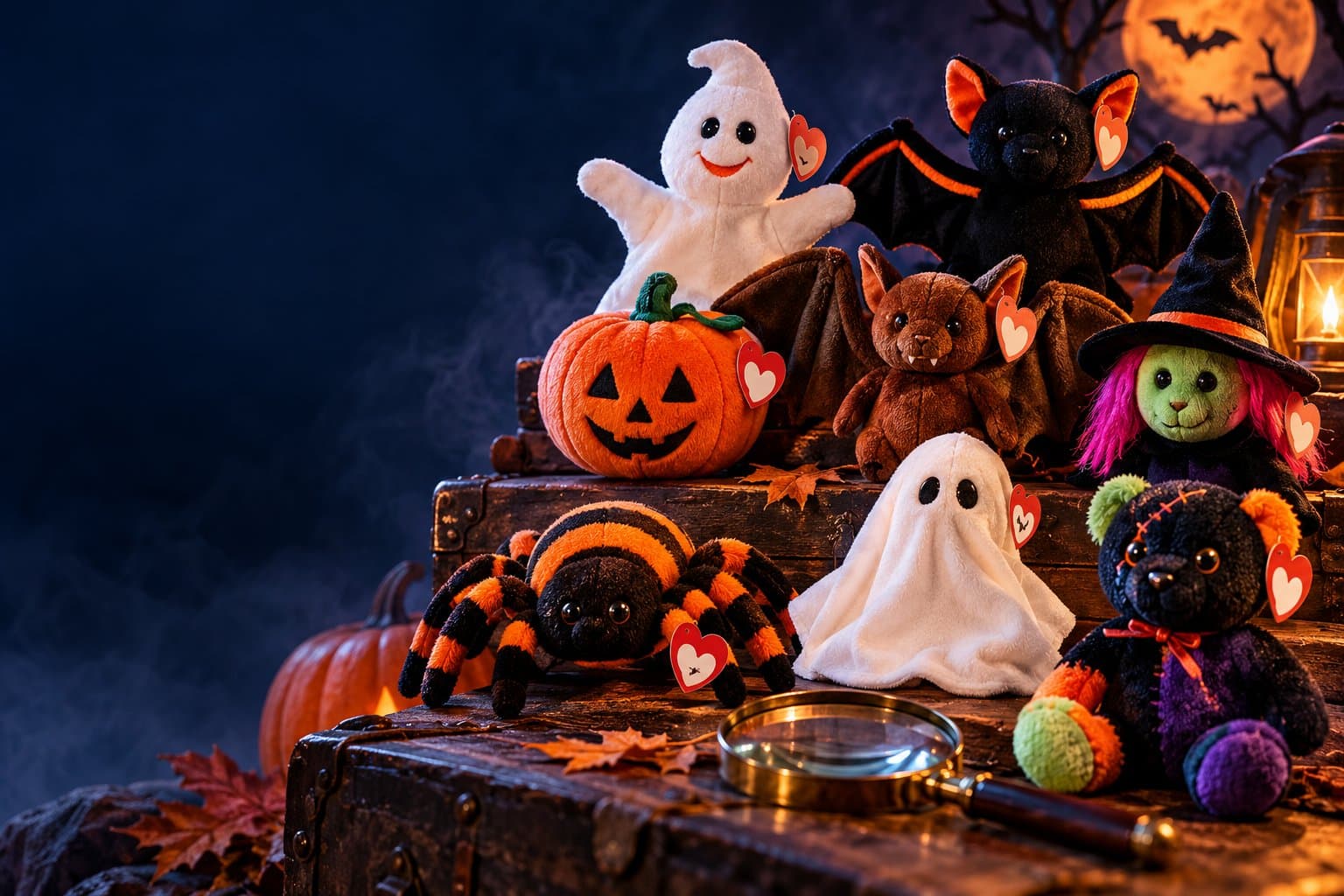
Halloween Beanie Babies With Errors: The Complete Collector’s Identification & Value Guide (2026)
From Spook’s famous name change to Spinner’s mysterious “Creepy” tag, discover the Halloween Beanie Baby errors, manufacturing oddities, and collectible variations worth investigating.
Halloween Beanie Babies occupy a special corner of Ty collecting. Ghosts, bats, spiders, witches, black cats, and jack-o’-lanterns have been part of the Beanie Baby universe since the mid-1990s, and some of the earliest releases have fascinating production histories.
But the real excitement for collectors often lies in the details.
A ghost with the wrong name on its tag. A spider labeled “Creepy” instead of “Spinner.” A bat with an extra foot. A Frankenstein-inspired teddy bear with a foot sewn on backward.
These aren't simply internet rumors. Several unusual Halloween Beanie Baby errors and production oddities have been documented by established collector references.
So which Halloween Beanie Babies have genuine errors, how can you identify them, and are any actually worth money?
This guide examines the most interesting documented examples, explains how to distinguish legitimate variations from damage or common printing differences, and compares their values using recent completed-sale data.
How Much Are Halloween Beanie Babies Worth in 2026?
Most ordinary Halloween Beanie Babies are relatively affordable. Many sell for approximately $5–$20, although early tag generations, limited-distribution editions, unusual factory mistakes, and authenticated specialty examples can command higher prices.
The following table summarizes reported median completed-sale prices from 2026.
| Beanie Baby | Style number | Approx. median sold price | |---|---|---:| | Spooky the Ghost | 4090 | $8.46 | | Radar the Bat | 4091 | $20.00 | | Batty the Bat | 4035 | $8.50 | | Spinner the Spider | 4036 | $7.00 | | Pumkin' the Pumpkin | 4205 | $4.68 | | Sheets the Ghost | 4260 | $6.49 | | Fraidy the Cat | 4379 | $8.00 | | Scary the Witch | 4378 | $5.50 | | Frankenteddy the Bear | 4562 | $7.58 | | SCARED-e the Cat | 4415 | $16.87 |
Pricing note: These are rounded or reported medians from third-party collections of completed eBay sales, principally updated during September–October 2026. They represent mixed-condition examples, not authenticated error-specific valuations. Automated sales matching may occasionally include different editions or lots. Prices are not guaranteed appraisals.
An important distinction: a documented error does not automatically make a Beanie Baby valuable. Its scarcity, condition, authenticity, collector demand, and demonstrated selling history matter far more than simply having an unusual tag.
1. Spooky and Spook the Ghost: One of Ty's Most Interesting Name Errors
Introduced: September 1, 1995 Style number: 4090 Birthday: October 31, 1995
Spooky is one of the earliest and most recognizable Halloween-themed Beanie Babies.
This little white ghost has black eyes, a simple embroidered face, and an intriguing history involving both its name and its original design credit.
The Spook-to-Spooky name change
When Ty introduced the ghost in September 1995, early third-generation heart tags identified the character as Spook, not Spooky.
The name was changed to Spooky in October 1995.
That makes the original Spook version a recognizable early-production collectible, rather than just a random tag misprint.
The “Desined” spelling error
Some early Spook swing tags contain a design credit to Jenna Boldebuck.
On these early tags, the word “Designed” was reportedly printed as “Desined.”
This creates an especially interesting combination for collectors:
- An early third-generation heart tag
- The original Spook name
- A misspelled design credit
- An early-generation tush tag
The early Spook tag also predates the familiar birthday poem printed on later Spooky tags.
Spooky’s mouth variations
Collectors may encounter Spooky ghosts with different mouth appearances, including variations in embroidered stitching and examples with or without a red felt mouth piece.
But caution is essential.
The red felt portion was glued onto some examples and could detach over time. Therefore, a Spooky without the red felt mouth cannot automatically be classified as a factory mistake.
An apparently missing mouth may represent ordinary damage.
Wrong tush-tag errors
Ty Collector also documents Spooky examples carrying tush tags intended for entirely different Beanie Babies, including Radar, Freckles, Mel, Spinner, and several others.
These mismatched tags are genuine categories of reported production oddities, although individual examples still require authentication.
What is Spooky worth?
Ordinary Spooky examples have a reported 2026 median selling price of approximately $8.46.
An early third-generation example with a first-generation tush tag and the Jenna Boldebuck credit was reported sold for $100 in July 2026.
However, that single sale should not be treated as the standard value of every early Spook or Spooky.
Early tags deserve individual research, especially when the name, designer credit, and tush-tag generation can all be documented.
Collector tip: Always photograph the front and inside of the heart tag. The difference between Spook and Spooky can be more significant than the ghost's physical appearance.
2. Spinner the Spider: The Famous “Creepy” Tush-Tag Error
Introduced: October 1, 1997 Style number: 4036 Birthday: October 28, 1996
Spinner is a small, black-and-gold striped spider with red eyes and eight legs.
At first glance, it looks like an ordinary Halloween collectible. Its production history, however, includes one of the better-known wrong-name tush tags.
The Spinner/Creepy error
During the spring of 1998, certain Spinner Beanie Babies appeared with the name “Creepy” printed on their tush tags, even though their swing tags identified them as Spinner.
Ty Collector records these examples as having been produced in Indonesia and distributed largely in the United Kingdom.
The documented combination includes:
- Fifth-generation swing tag
- Sixth-generation tush tag
- Spinner on the swing tag
- Creepy on the tush tag
- Indonesian production association
This is not merely a spelling variation. It is an entirely different name appearing on the fabric label.
Other documented Spinner errors
Spinner also has several reported factory oddities:
- An example with part of its back made from fuzzy fabric
- Examples carrying tush tags belonging to Batty, Hoot, Legs, Nanook, and Snort
These are substantially different from mass-produced printing quirks.
What is a Spinner with the Creepy error worth?
Ordinary Spinner examples have a reported median completed-sale price of approximately $7.
A collector price guide has historically estimated Creepy-tagged Spinner examples at around $12–$25, but actual sales can vary considerably.
One Creepy-tagged Spinner reportedly sold for $20 in September 2026, while a UK example sold for only £3.10 in August 2026.
This illustrates an important point: even a real, documented error is not guaranteed to sell at a premium.
Collector tip: Search specifically for “Spinner Creepy tush tag Indonesia” when looking for comparable examples. Avoid using ordinary Spinner listings to value the unusual label.
3. Radar the Bat: Missing Ears, Extra Feet, and Wrong Labels
Introduced: September 1, 1995 Style number: 4091 Birthday: October 30, 1995
Radar is another early Halloween favorite.
This dark-colored bat, with spread wings and distinctive facial features, dates to the same introductory period as Spooky.
Early Radar examples can be particularly interesting because of their tag generations and documented construction mistakes.
Known Radar factory oddities
Ty Collector records several unusual Radar examples, including:
- A Radar with three feet
- An example with three thumbs and a tush tag attached where a foot would normally appear
- A Radar missing a foot
- A Radar missing an ear
- Examples carrying incorrect tush tags, including Hoot, Ringo, Stinky, and Velvet
A bat with an additional factory-attached appendage is a very different situation from a bat whose original foot has been torn off.
How to identify a real Radar production mistake
Look closely at the seams and construction.
An authentic extra appendage should have stitching and materials consistent with factory manufacture. A missing appendage needs careful examination to exclude damage.
Because counterfeit Radar examples are also documented, unusual specimens require additional scrutiny.
Radar Beanie Baby value
Radar's reported median selling price was approximately $20 in October 2026, higher than many common Halloween Beanies.
Some early or better-preserved examples have sold for considerably more.
However, the market has not established a reliable general price for every extra-foot, missing-ear, or mismatched-tag Radar.
These examples should be assessed individually.
Collector tip: Earlier tags can be more important than a questionable physical defect. Document both before assigning a premium.
4. Batty the Bat: Wrong Tush Tags and Two Legitimate Color Versions
Introduced: October 7, 1997, for the brown version Style number: 4035 Birthday: October 29, 1996
Batty is famous for its wings, which use hook-and-loop fasteners so the bat can wrap itself up.
It was the first Beanie Baby to use this feature.
Brown Batty vs. tie-dye Batty
Two recognized appearances exist:
Brown Batty: A brown or mocha-toned bat.
Tie-dye Batty: A multicolored version with a distinctly different fabric appearance.
The tie-dye coloring is intentional and should not be described as a manufacturing mistake.
Documented Batty tush-tag mistakes
Ty Collector lists Batty examples with tush tags associated with:
- Bongo
- Peace
- Ringo
- Roary
- Zip
These incorrect labels may attract error collectors, provided the tags are original to the toys.
How much is Batty worth?
Reported completed sales for Batty had a median of approximately $8.50 in early October 2026.
Specific sales in that period ranged from a few dollars to the mid-teens for many ordinary examples.
A mismatched tush tag may justify additional investigation, but the presence of a common copyright date or pellet description alone does not establish unusual value.
Collector tip: Photograph Batty with its wings both open and closed. The fasteners, fabric, and attached tags are important identification details.
5. Frankenteddy: Six Official Foot Variations and a Backward-Foot Error
Introduced: August 29, 2002 Style number: 4562 Birthday: October 31, 2001
Frankenteddy is one of Ty's most visually distinctive Halloween bears.
Its patchwork appearance makes it a natural favorite among collectors who enjoy unusual plush designs.
Six legitimate foot-color combinations
Ty officially produced six Frankenteddy variations:
| Left foot | Right foot | |---|---| | Blue | Red | | Purple | Red | | Purple | Green | | Blue | Purple | | Blue | Orange | | Green | Blue |
These combinations are intentional variations, not factory errors.
The backward-foot production mistake
Ty Collector separately documents a Frankenteddy with a foot sewn on backward.
This is the sort of manufacturing anomaly collectors should distinguish from the six planned color combinations.
To evaluate one, compare the foot's orientation, seams, and construction against verified examples.
The unusual black-foot prototype
There is also a fascinating Frankenteddy prototype story.
A Ty-signed prototype with two black feet was auctioned through Ty's website in October 2002 to benefit UNICEF.
That prototype is not simply a seventh retail color variation.
It belongs to a different category of collectible because of its prototype status, signature, and documented auction history.
Frankenteddy value
Ordinary Frankenteddy examples had a reported 2026 median sold price of approximately $7.58.
Some tagged examples sold in the $15–$20 range.
A documented backward-foot factory error or genuine prototype would require a separate valuation. Ordinary retail sales do not establish prices for those unusual pieces.
Collector tip: If you discover an unusual foot configuration, photograph both feet from above, below, and the side before deciding it is an error.
6. Pumkin' the Pumpkin: Is the Missing “P” an Error?
Introduced: September 30, 1998 Style number: 4205 Birthday: October 31, 1998
Pumkin' is an orange jack-o'-lantern-style Beanie Baby, and its name regularly leads to confusion.
The word pumpkin is normally spelled with two P's.
Ty's character, however, is deliberately named Pumkin'.
Is “Pumkin'” a rare spelling mistake?
No.
The official character name is Pumkin', and that spelling does not make an ordinary example rare.
This is an excellent example of how an unusual-looking word can generate misleading online advertisements.
What should collectors inspect?
When evaluating Pumkin', check the style number, fifth-generation swing tag, sixth-generation tush tag, stem, facial details, fabric, and overall condition.
An unrelated printing anomaly would need to be verified separately.
Pumkin' Beanie Baby value
Pumkin' had a reported median completed-sale price of approximately $4.68 during September 2026.
A listing advertising a “rare misspelled pumpkin” does not establish a premium when that spelling is the official product name.
Collector tip: Search for both “Pumkin' Beanie Baby” and “Pumkin Ty 4205” to find comparable sales without confusing the name with actual errors.
7. Sheets the Ghost: A Later Halloween Favorite
Introduced: August 31, 1999 Style number: 4260 Birthday: October 31, 1999
Sheets followed Spooky as another ghost in Ty's Halloween lineup.
The two characters are easy to confuse in poorly photographed online listings, but they are separate releases with different construction and tag generations.
Sheets is associated with a fifth-generation swing tag and eighth-generation tush tag.
Are there valuable Sheets errors?
Unlike Spook and Creepy-tagged Spinner, Sheets does not have a similarly prominent, well-documented name-change error in the collector references reviewed here.
An unusual tag or apparent production flaw should therefore be verified rather than assumed to be a known rare variety.
Sheets Beanie Baby value
Reported median completed-sale value: $6.49.
Well-preserved tags and clean white fabric are important to its resale appeal.
Collector tip: Check for discoloration, staining, or yellowing before buying a white Halloween Beanie Baby for resale.
8. Fraidy, Scary, and SCARED-e: Halloween Cats and Witches
Ty expanded its Halloween assortment in the early 2000s with several memorable characters.
These three are particularly worth distinguishing because online sellers sometimes mix together their release dates, names, or product lines.
Fraidy the Cat
Style number: 4379 Introduced: September 3, 2001 Reported median value: $8
Fraidy is a black Halloween cat with orange accents.
It is also notable for an intentional design feature: Ty Collector identifies Fraidy as the first Beanie Baby to feature an animal design on its ribbon.
That ribbon design is not an error.
Look for correct accessories, the proper character name, and a tag consistent with the original release.
Scary the Witch
Style number: 4378 Introduced: September 3, 2001 Reported median value: $5.50
Scary is a colorful witch character with green facial features, bright hair, and a pointed hat.
Collectors should check the hat, clothing, stitching, hair, and both labels.
Missing decorations or visibly damaged accessories are not automatically rare factory mistakes.
SCARED-e the Cat
Style number: 4415 Introduced: October 2, 2002 Reported median value: $16.87
SCARED-e is a Ty Store exclusive Halloween cat.
Its distinctive capitalized and hyphenated spelling is an official name, not a typo.
The original Beanie Baby should also be distinguished from later Halloweenie Beanies and Beanie Buddies versions of similar characters.
SCARED-e's limited original distribution makes it a particularly interesting Halloween collectible.
A signed SCARED-e attributed to Ty Warner was reported sold for $395 on October 25, 2026. That price reflects an exceptional signed example, not the value of an unsigned retail SCARED-e.
Collector tip: Always confirm the product line and style number before treating a high-priced or signed example as a comparable sale.
Every Major Type of Halloween Beanie Baby Error Explained
Not all errors are created equal. In fact, they fall into several different categories, each with its own identification challenges.
| Error or variation type | Example | What it means for value | |---|---|---| | Original name subsequently changed | Spook → Spooky | Potentially collectible early production | | Incorrect character name on tag | Spinner with Creepy tush tag | Documented variation; premiums inconsistent | | Incorrect spelling in early printed credit | “Desined” on early Spook tag | Supports identification of an early tag variety | | Wrong character's tush tag | Batty with Zip tag | May interest specialized error collectors | | Extra factory-sewn body part | Radar with three feet | Individual authentication and valuation needed | | Missing body part | Radar missing an ear | Must rule out damage | | Reversed body part | Frankenteddy with backward foot | Reported factory construction oddity | | Unusual fabric construction | Spinner with partially fuzzy back | Must verify original manufacture | | Planned color variation | Six Frankenteddy foot combinations | Not an error | | Planned tie-dye version | Batty tie-dye | Not an error | | Unusual official name | Pumkin', SCARED-e | Not an error | | Lost or detached decoration | Spooky without red felt mouth | Not proof of a factory error |
What about PVC pellets, PE pellets, and factory stamps?
Collectors also regularly encounter listings emphasizing pellet types, country-of-origin differences, copyright dates, and factory-stamp numbers.
These can be useful for identifying a release.
But none of them automatically makes a Halloween Beanie Baby valuable.
For example, a stamp inside a tush tag may help document a particular production batch. It does not, by itself, demonstrate that the item was produced in unusually small quantities.
Likewise, a different pellet material is not automatically an error.
A meaningful valuation requires evidence that collectors consistently pay more for the exact configuration.
How to Identify Authentic Halloween Beanie Baby Errors
If you think you've discovered an unusual Halloween Beanie Baby, inspect it systematically.
Step 1: Identify the exact character
Start with the Beanie's name and style number.
Avoid relying on color alone. Multiple Halloween releases feature similar ghosts, bats, black cats, and pumpkins.
Confirm whether you have a Beanie Baby, Beanie Buddy, Halloweenie Beanie, Beanie Boo, or another Ty product.
Step 2: Examine the heart-shaped swing tag
Photograph the front and inside of the heart tag.
Look for the character name, tag generation, poem or text, copyright information, punctuation, and any unusual printing.
Early tag generations may be especially important for Spook, Spooky, and Radar.
Step 3: Inspect the tush tag
The fabric label can help establish the name, production era, manufacturing location, and tag generation.
A wrong-name tush tag is most persuasive when its appearance, material, stitching, and period are consistent with factory attachment.
A tag that has been removed and resewn is not equivalent to an original factory mismatch.
Step 4: Compare physical construction
Look for extra appendages, inverted feet, unusual fabric panels, missing embroidery, and other visible differences.
Determine whether the feature was intentionally produced, accidentally manufactured, damaged, or altered after purchase.
Step 5: Check for counterfeit indicators
Counterfeit Spooky and Radar examples are documented.
An unusual name or tag should lead to more careful authentication, not an immediate assumption of rarity.
Compare fabric, construction, stitching, tag printing, and age-related wear with reliable references.
Step 6: Research completed sales
Search eBay's Sold Items filter using the exact character, error, and tag generation.
Compare the selling price—not the advertised asking price.
Where possible, evaluate multiple completed sales of the same variation and similar condition.
For unusual examples without reliable comparable sales, avoid assigning an enormous speculative value.
Step 7: Consider professional authentication
A genuinely unusual factory error can be difficult to establish from photographs alone.
For an early-tag collectible, rare documented mismatch, unusual construction mistake, or potentially counterfeit specimen, professional inspection may help establish authenticity and condition.
Collectors can explore BeanieXchange Authentication & Grading for information about the authentication process.
Why Are Some Error Beanie Babies Listed for Thousands of Dollars?
Search for vintage Beanie Baby errors online, and you'll quickly find asking prices of hundreds, thousands, or even tens of thousands of dollars.
These prices often reflect what sellers hope to receive—not what buyers have paid.
Several misleading assumptions are especially common:
- A misspelled word must be a rare error.
- An older copyright date automatically makes a Beanie valuable.
- PVC pellets guarantee a premium.
- Every wrong tag is a unique, one-of-one factory mistake.
- An unusually high asking price proves market value.
None is universally true.
Real value comes from a combination of documented scarcity, verifiable authenticity, excellent condition, and actual collector demand.
A rare early-generation release with complete provenance may be genuinely desirable. A mass-produced character with an ordinary printing difference may remain worth only a few dollars.
**The strongest evidence of value is a history of buyers paying a premium for the exact variation