
Beanie Babies Are Back: Why a New Generation Is Rediscovering the ’90s Collecting Phenomenon
BeanieX Team · August 24, 2026
# Beanie Babies Are Back: Why a New Generation Is Rediscovering the ’90s Collecting Phenomenon For anyone who lived through the 1990s, the sight of a tiny red heart-shaped tag can trigger an almost immediate memory. Beanie Babies weren’t simply stuffed animals. They were collectibles, gifts, investments, playgrou
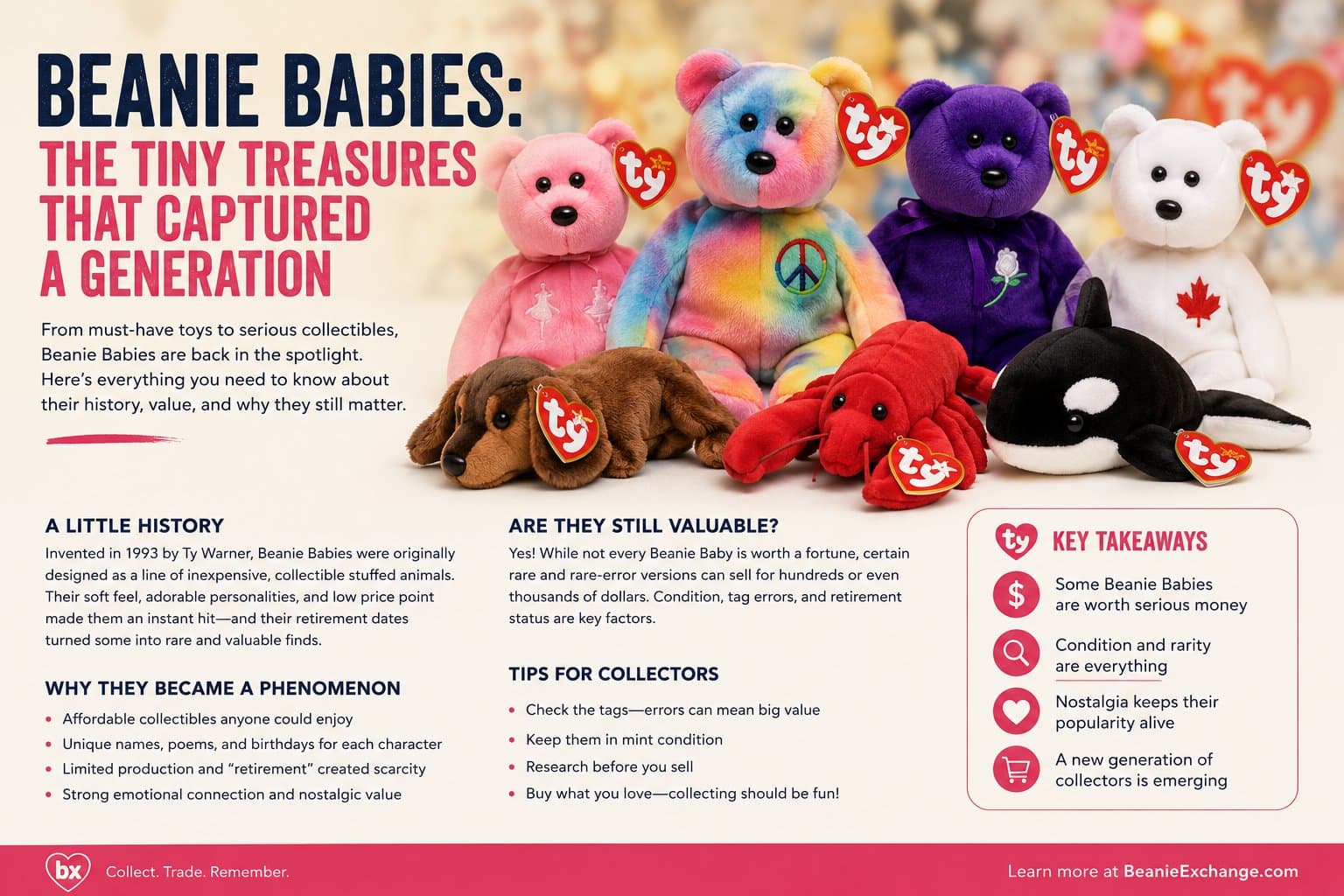
Beanie Babies Are Back: Why a New Generation Is Rediscovering the ’90s Collecting Phenomenon
For anyone who lived through the 1990s, the sight of a tiny red heart-shaped tag can trigger an almost immediate memory.
Beanie Babies weren’t simply stuffed animals. They were collectibles, gifts, investments, playground currency and, for a few chaotic years, the center of one of the biggest collecting crazes America had ever seen.
Then the frenzy disappeared almost as quickly as it arrived.
More than three decades after the first Beanie Babies hit stores, however, something interesting is happening: people are collecting them again.
And this time, the Beanie Baby market looks very different.
How Beanie Babies Became a Phenomenon
Ty Warner introduced Beanie Babies in 1993 with a deceptively simple idea: small, affordable plush animals partially filled with plastic pellets, giving them a floppy feel unlike most stuffed toys of the era.
They were inexpensive enough for children to buy but distinctive enough to collect.
Each character had a name. Later releases included birthdays and short poems printed inside their heart-shaped hang tags. New animals appeared regularly, while others were suddenly “retired.”
That retirement strategy changed everything.
Once collectors realized a particular Beanie Baby might disappear from stores permanently, buying became urgent. People weren't necessarily purchasing one bear—they were hunting for every character, color variation and tag generation they could find.
Scarcity became part of the experience.
By the late 1990s, Beanie Babies had become a full-fledged cultural phenomenon.
The Great Beanie Baby Gold Rush
At the height of the craze, collectors lined up outside stores waiting for new shipments.
Secondary-market prices exploded. Collector magazines published price guides. Early internet communities traded information about supposedly rare variations. Newspaper stories featured people whose collections were allegedly worth enormous sums.
McDonald's further fueled the frenzy with its enormously popular Teenie Beanie Babies promotions.
And then there was Princess.
Released in memory of Diana, Princess of Wales, the purple Princess bear became perhaps the ultimate symbol of Beanie Baby mania. Rumors about limited production and enormous future values spread rapidly.
Beanie Babies suddenly felt less like toys and more like assets.
That perception couldn't last forever.
The Bubble Bursts
By the end of the decade, supply had increased dramatically while speculative demand began disappearing.
Collectors who had carefully stored tubs of Beanie Babies expecting to finance college tuition or retirement discovered an uncomfortable truth:
Most Beanie Babies weren't particularly rare.
Millions had been produced.
When everyone saves something because they believe it will become collectible, surviving supply can remain enormous decades later.
Prices collapsed, and Beanie Babies became shorthand for the dangers of speculative collecting.
But that isn't the end of the story.
No, Your Beanie Baby Probably Isn't Worth $50,000
Search for almost any older Beanie Baby online today and you're likely to encounter extraordinary asking prices.
$5,000.
$20,000.
$100,000.
Unfortunately, an asking price isn't the same thing as market value.
Anyone can list an item online for virtually any price. What matters is whether somebody actually buys it.
Serious collectors look at completed sales, authenticated examples and comparable specimens—not sensational listings that may sit unsold indefinitely.
That doesn't mean valuable Beanie Babies don't exist.
They absolutely do.
The challenge is identifying the genuinely scarce pieces among millions of common examples.
What Actually Makes a Beanie Baby Valuable?
There isn't one magic characteristic.
Value generally comes from a combination of rarity, version, provenance and condition.
Early-generation Beanie Babies can be significantly more desirable than later mass-produced examples. Certain retired designs, unusual production variations and legitimate manufacturing oddities can also attract serious collectors.
Tags are especially important.
Collectors examine both the heart-shaped swing tag and the fabric tush tag. Tag generation can help identify when a Beanie Baby was produced, while condition can dramatically affect desirability.
A pristine tag attached to an equally clean Beanie is very different from a bent, stained or missing tag.
And contrary to countless viral posts, a random typo doesn't automatically transform a $5 Beanie Baby into a $5,000 collectible.
Context matters.
The Counterfeit Problem
The enormous prices reached by desirable Beanie Babies during the original craze created another problem: counterfeits.
Some highly sought-after Beanies were reproduced surprisingly convincingly.
Collectors therefore examine details including tag printing, fonts, stitching, fabric, proportions, pellet composition and manufacturing characteristics when evaluating questionable examples.
For expensive pieces, authentication can become an important part of establishing confidence between buyers and sellers.
As the hobby matures, provenance and third-party authentication may become increasingly important—similar to what happened in coins, trading cards, comics and other established collectible categories.
Why Beanie Babies Are Interesting Again
The generation that grew up with Beanie Babies is now well into adulthood.
That matters.
Collectible markets frequently move in cycles as adults regain interest in objects they loved as children. Pokémon cards, vintage video games, sneakers, action figures and countless other categories have experienced similar nostalgia-driven revivals.
Beanie Babies have another major advantage:
They're still accessible.
You don't need thousands of dollars to participate.
A new collector can walk into a thrift store, antique mall, estate sale or flea market and potentially come home with several Beanies for the price of lunch.
At the same time, advanced collectors can hunt for early generations, unusual variants, prototypes and genuinely scarce pieces.
That combination gives the hobby an unusually low barrier to entry.
The Thrill of the Hunt Is Back
Perhaps the most compelling part of modern Beanie Baby collecting is that these toys are everywhere—but the good ones aren't.
Millions remain tucked away in attics, closets and storage bins.
Collections assembled during the 1990s are continually reappearing through estate sales, thrift stores and online marketplaces.
Most contain common Beanies.
Occasionally, however, something much more interesting appears.
That possibility transforms a box of forgotten stuffed animals into a treasure hunt.
Collectors aren't simply buying Beanie Babies anymore.
They're rediscovering them.
Collect What You Love
The original Beanie Baby craze became distorted when collecting turned almost entirely into speculation.
The modern hobby has an opportunity to be different.
Buy the characters you remember.
Build a collection around bears, sea creatures or holiday releases. Hunt early generations. Collect every version of one character. Search for pristine tags. Display them instead of sealing them away in plastic tubs for another 30 years.
And if you stumble across something genuinely rare?
Even better.
Beanie Babies were created to be affordable, charming little collectibles. Ironically, returning to that original idea may be exactly what allows them to thrive again.
Because somewhere right now, another dusty box of 1990s Beanie Babies is being opened for the first time in decades.
And collectors are once again wondering:
What's in there?