
Beanie Reference
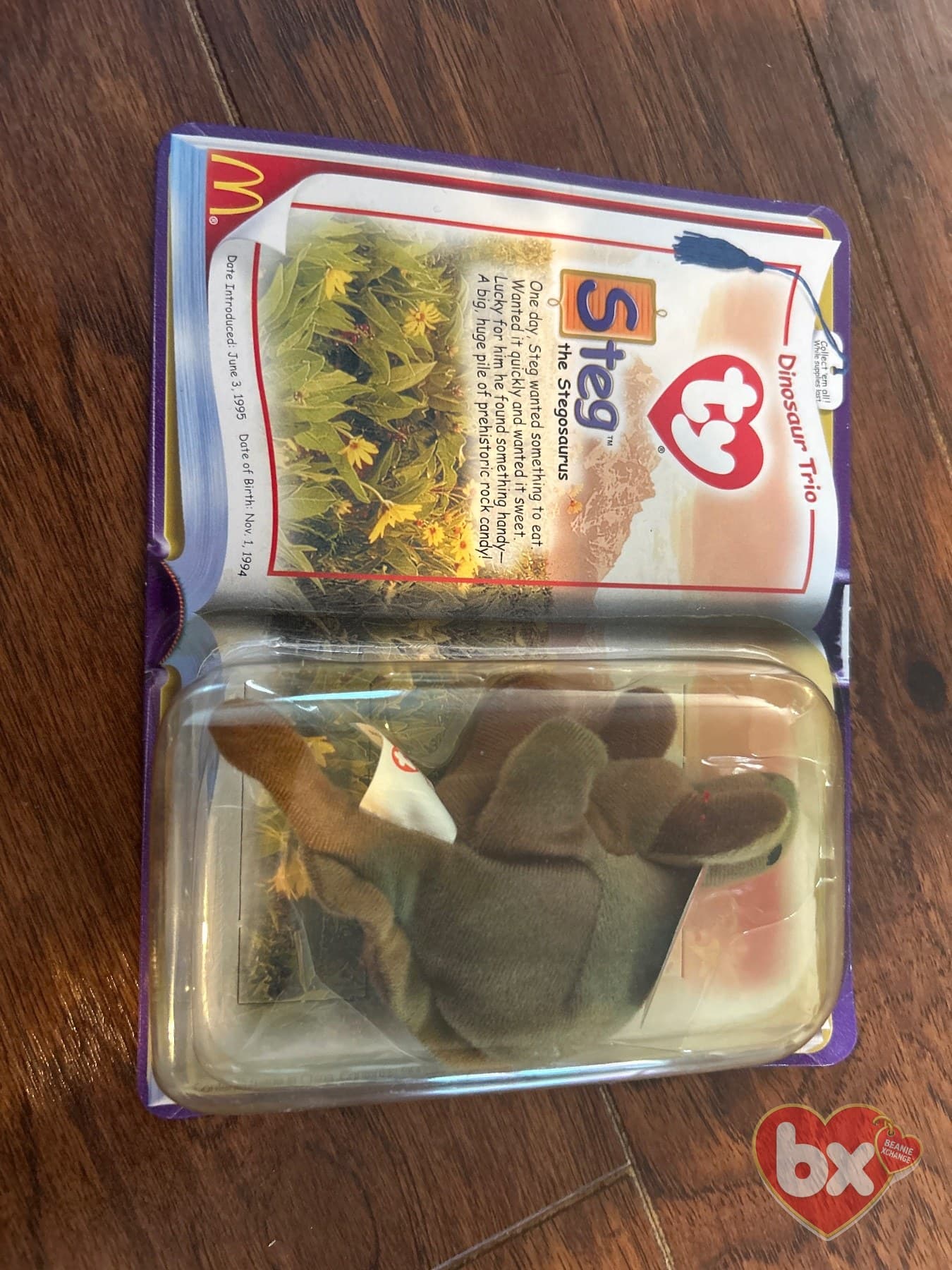
Steg the Beanie Baby Value & Tag Guide
Everything on file for Steg the Beanie Baby: release facts, the swing-tag generations it can legitimately carry, what to inspect before you believe it's genuine, and every completed sale we have documented — with the date and condition attached.
What is the Steg Beanie Baby worth?
Steg is generally estimated at $60–$200 for an authentic example in excellent condition with a clean swing tag. That is a collector estimate, not a record of completed sales — we have no documented sales for Steg on file yet.
No completed-sale record on file for this beanie yet. Asking prices are not values; a beanie is worth what one has recently sold for.
Release facts
- Animal
- Stegosaurus
- Category
- Dinosaurs
- Introduced
- 1995
- Ty style number
- 4087
- Ty birth date
- Nov 1, 1995
- Catalogue
- Curated original era (1993–1999)
Collector note: Tie-dye; retired 1996.
Documented sold prices
No completed sales are on file for Steg yet. We only publish sales we have actually recorded, so this section stays empty rather than filling up with asking prices. See price trends for beanies that do have a sales record.
Steg for sale on BeanieXchange
These are asking prices on current listings, not sale prices. They are what sellers want today; the section above is what buyers have paid.
- Steg
$80.00 · MWMT — Mint With Mint Tags
- Ty Beanie Baby Steg the Stegosaurus 1995 Style #4087 Retired Tie-Dye
$130.00 · Good vintage condition — full photos coming soon
- Steg
$250.00 · EX — Excellent
Which tag generation should Steg have?
Steg was introduced in 1995, so the earliest swing tag it can legitimately carry is a 2nd generation tag. Later generations are normal — popular beanies stayed in production for years — but an earlier generation than the release means a swapped tag, a misidentified beanie, or a fake.
2nd generation (current on new releases 1994–1995)Release tag
The first tag that folds open like a book, still with no star on the front. Inside carries the name and style number.
3rd generation (current on new releases 1995–1996)
A gold star appears on the front and the 'ty' letters become rounder and fatter.
4th generation (current on new releases 1996–1997)
The star reads 'BEANIE ORIGINAL BABY' and the inside gains the beanie's birth date and its poem.
5th generation (current on new releases 1998–1999)
Narrower 'ty' lettering and a slimmer typeface inside; the Ty web address is referenced.
6th generation (current on new releases 1999–2000)
A holographic/foil star in place of the flat gold one.
7th generation and later (current on new releases 2000 onward)
Post-2000 tag styles, including the later hologram and authenticator variants.
Tag-generation year windows are collector consensus and overlap at the edges, because Ty changed tags mid-production run. The physical tag is always the authority — and before you pay a premium for an “error” tag, read which tag errors actually matter.
How to spot a fake Steg
- Tag generation vs. release year. Steg was introduced in 1995, so the earliest swing tag it can legitimately carry is a 2nd generation tag. An example offered with an earlier-generation tag has had a tag swapped onto it, is a different beanie, or is fake.
- Pellet type. Ty used PVC pellets on early production and switched to PE pellets around 1998. A pre-1998 release that is filled with PE pellets is a later run at best — it is not the early example its tag may claim to be.
- Style number. The tush tag and the inside of the swing tag should both read style 4087. A mismatch between the two tags is one of the most common fake tells.
- Birth date. The inside of a 4th-generation or later tag should read Nov 1, 1995. Fakes frequently get the poem right and the date wrong.
- Tag print quality. Genuine swing tags are printed on stiff, glossy card with crisp edges on the star and clean, evenly spaced type. Fuzzy edges, bleeding ink, or type that sits at a slight angle are reprint tells.
- Tush tag. Check the font weight and spacing, the position of the ® and ™ marks, and that the stated country of manufacture is one Ty actually used for this era.
- Documented errors only. Tag misspellings are only valuable when they are a known, documented Ty error. An undocumented 'error' is far more likely to be a counterfeiter's mistake than a find.
- Construction. Seams should be machine-stitched, tight and even, with symmetric eye and nose placement and no glue. Loose or glued features are a strong fake signal.
- Fabric and color. Over-bright, over-fuzzy, or plasticky fabric on a supposed 1990s release usually means a modern reproduction.
Checks that need the item in hand are exactly what our authentication process performs. More background in the rarity guide and beanie info.
Own a Steg?
Have it authenticated and list it here — every sale is escrow-protected, and every authenticated item carries a sealed COA and a permanent BX Registry number.
Reference values are collector estimates; documented sale prices come from recorded completed eBay listings. Not affiliated with Ty Inc. or eBay. Beanie Babies® and Ty® are trademarks of their respective owner. Back to the full Beanie Baby database.